

The devastation was real. Between March 2000 and October 2002, the NASDAQ collapsed 78%, erasing approximately $5 trillion in market value. The technology sector shed 540,000 jobs in just two years. In Silicon Valley, unemployment surged from 1.3% to 8%, and nearly one in four unemployed workers remained jobless for more than 27 weeks. Santa Clara County lost more than 200,000 jobs – the largest decline for any metropolitan area since the Great Depression.
I arrived at Infoseek in the mid-1990s during the bubble, then left for a startup that would later appear on F***edCompany.com’s failure tracker. Infoseek would end up on that list too, after Disney shut it down. I watched colleagues leave one dying company only for their next company to die, sometimes repeating this pattern three or four times. Some eventually left tech entirely – they couldn’t take another company dying under them.
At an east coast dinner party that I attended during the worst of it, a Fortune 500 CFO declared that dot-com companies “were not real companies” and the people who worked at them “were not real business people.” “Real companies,” he insisted, would never hire them. That CFO’s company was subsequently acquired; its brand name has since disappeared. Amazon’s market cap now exceeds $2 trillion.
Legacy carriers celebrating insurtech failures today are making the same analytical error. The pattern is identical: massive crash, schadenfreude from incumbents, quiet building by survivors, eventual market transformation. The only question is whether you recognize the pattern early enough to act on it.
No Bailouts, Real Consequences
Unlike 2008’s bank bailouts or 2020’s pandemic relief, the dot-com crash received no government intervention. Nobody felt sorry for tech workers who had gambled on stock options. Pets.com’s $300 million, Webvan’s $800 million, Excite@Home’s $35 billion – all vaporized with no safety net.
The cruelty extended to employees who thought they’d done everything right. The Alternative Minimum Tax trapped workers who exercised stock options at peak valuations, then watched prices collapse. They owed six-figure or seven-figure tax bills on gains they never realized, on stock now worth pennies. Some filed personal bankruptcy specifically because of stock option tax obligations. One local executive purchased 240,000 shares at $0.14 when the stock traded at $19.75 – $4.7 million in paper value for $33,700. By year-end the shares were worth $45,600, but he faced a tax bill exceeding $1 million.
Drive through Silicon Valley today and the landscape tells the destruction story. A former Sun Microsystems satellite office, where Oracle briefly hung a sign over the old logo before shutting it down, is now Facebook’s headquarters. The former Silicon Graphics headquarters, which I visited during my Infoseek days when SGI dominated CGI for film and television, is now Google’s headquarters. Both companies failed for the same reason: no answer to the x86 chip. The buildings survived. The companies that couldn’t adapt didn’t.
But this matters: because there were no bailouts, creative destruction actually worked. Bad companies and bad management teams faced consequences. Investors who bet on unsustainable models lost their money. Capital was reallocated from failures to survivors. The painful clearing created the foundation for what came next.
The Dot-Com Timeline: From Mania to Dominance

The NASDAQ peaked at 5,048.62 on March 10, 2000. It bottomed at 1,114.11 on October 9, 2002 – 30 months of destruction. Amazon’s stock crashed 94%, from $107 to $6. Priceline fell 99%, from $974 to $6.60. Cisco lost 90% of its value and didn’t recover its March 2000 peak until December 2025, 25 years later.
Then came the quiet period. From 2002 to 2005, while incumbents relaxed and the media wrote post-mortems on the “dot-com folly,” the survivors built. Amazon posted its first profitable quarter in Q4 2001 – during the depths of the crash. Rather than cutting, Bezos expanded into new categories and began developing the infrastructure that would become AWS. Google went public in August 2004, four years after the peak and two years after the trough, proving that world-class businesses could launch in the aftermath of a crash.
The NASDAQ didn’t return to its March 2000 level until April 2015, 15 years later. But the survivors didn’t just recover; they obliterated their incumbents. Amazon’s market cap now exceeds Walmart’s by multiples. Google and Facebook captured the digital advertising revenue that newspapers thought they’d protected by surviving the crash. Netflix, founded in 1997 and nearly sold to Blockbuster for $50 million in 2000, introduced streaming in 2007 and now dominates global entertainment.
The Insurtech Timeline: Where We Are Now
Global insurtech funding rose from approximately $1.5 billion in 2015 to a peak of $15.8 billion in 2021 – a single year that accounted for more capital than the previous five years combined. The public market euphoria was even more extreme. Lemonade peaked at $188 per share in January 2021, valuing the company at over $10 billion despite less than $100 million in revenue. Root peaked at $486 (split-adjusted) in late 2020.
Overlay the timelines. Dot-com: bubble inflation 1995-2000 (5 years), peak March 2000, crash 2000-2002 (2.5 years), quiet period 2002-2007. Insurtech: bubble inflation 2015-2021 (6 years), peak 2021, crash 2022-2024 (2-3 years). We are now approximately 3-4 years post-peak – the equivalent of 2003-2004 in the dot-com cycle.
This is the quiet period. And the survivors are building.
Survivor Patterns Across Eras
The dot-com survivors shared specific characteristics. Amazon achieved profitability during the crash and used the quiet period to build AWS rather than retreat. Google focused on engineering headcount and infrastructure while competitors cut R&D. Netflix continued investing in its DVD unit economics while developing the streaming capability that would launch in 2007. All prioritized unit economics over growth-at-all-costs. All had founder leadership through the crisis. All treated the crash as an opportunity to build capabilities rather than a signal to harvest.
The insurtech survivors display identical patterns. Root Insurance achieved its first full year of GAAP profitability in 2024 – $31 million net income and $112 million adjusted EBITDA – with gross loss ratios improving from over 90% during its crisis years to approximately 59% in late 2025. The company didn’t just survive; it fundamentally restructured its underwriting and abandoned shotgun marketing for embedded distribution. Founder Alex Timm remains CEO, a rarity among 2015-era insurtechs.
Coalition’s gross written premiums exceeded $630 million in 2023, up roughly 15% year‑over‑year, and its July 2022 funding announcement cited over $775 million in run‑rate Gross Written Premium (GWP). maintaining a $5 billion valuation through its “Active Insurance” model that combines security software with risk transfer. Its loss ratios consistently outperform industry averages because it actively scans policyholders and prevents claims before they happen – a capability legacy carriers physically cannot replicate without rebuilding their tech stacks.
Next Insurance’s $2.6 billion acquisition by Munich Re validated the digital small business thesis. Shift Technology processes claims and documents at scale across 115+ insurance customers worldwide, with a SaaS delivery model distinct from traditional risk-bearing underwriting economics. Newfront’s acquisition by WTW for up to $1.3 billion proved that modernizing the brokerage model was faster than replacing it.
The Pattern Holds: B2B Infrastructure Outperforms Capital-Intensive Carriers
B2B insurance infrastructure software achieves 70-80% gross margins, substantially exceeding the operating economics of capital-intensive insurance carriers, which face combined ratios of 97-102% and net profit margins below 3% on underwriting alone (with some health insurers and new insurtechs showing negative net margins when investment income is excluded).
Commercial lines insurance commands significantly higher premiums than personal lines – middle market commercial policies typically range from $50,000 to $1,000,000 annually, compared to personal auto insurance averaging $2,300-$2,677 for full coverage and $627-$916 for minimum liability coverage. This premium variance creates superior economics for intermediaries focused on commercial segments, which often generate 10-15x greater commission income per policy than personal lines.
Embedded insurance distribution achieves three to four times lower customer acquisition costs compared to direct-to-consumer models, reducing traditional insurance CAC of $487–$1,280 per customer to an estimated $122-$300 range by leveraging contextual sales at the point of transaction. This distribution advantage, combined with infrastructure-like unit economics, explains why platforms prioritize embedded partnerships over direct distribution.
Strategic and patient capital from family offices (increasingly allocating to insurance for uncorrelated returns), reinsurers (backing a record 51 insurtech investments in Q3 2025), and incumbent carriers replace traditional Silicon Valley venture capital, which has retreated due to structural timeline misalignment – VC funds with 5-7 year lifecycles cannot accommodate insurance businesses requiring 7-10 years to achieve sustainable profitability. Public insurtech exits declined 79% since 2021, with only six exits recorded in 2024, forcing founders toward strategic and family office investors with permanent capital structures.
The Infrastructure Provider Warning: Sun Microsystems and Nvidia
I didn’t just observe Sun Microsystems from the outside. Infoseek was Sun’s second-largest customer after Intel. As head of content and technology licensing, I worked with Sun constantly. There were waiting lists for Sun’s latest and most powerful servers – actual waiting lists, not marketing gimmicks. Your position in Sun’s allocation queue signaled your importance in the technology hierarchy. Getting a top server meant you mattered.
Sun’s market cap peaked above $250 billion. The company’s slogan was “We put the dot in dot-com.” Its products were genuinely revolutionary – Java, Solaris, SPARC. Its customers were real. Its profits were real. At peak, Sun reported $2 billion in net income.
Years later at @Road – one of the last companies to IPO before the crash, and a survivor – the first data deliveries to telematics data customers were still powered by Sun servers. I watched Sun across the entire arc: essential infrastructure provider with waiting lists, the company everyone needed, sold to Oracle in 2010 for $7.4 billion. A 97% discount from peak. The company that powered the boom couldn’t survive the bust.
The demand collapse was the trigger, but not the full story. Sun had scaled operations to meet unsustainable demand from customers who subsequently vanished – when dot-coms failed en masse, they stopped buying servers. But the deeper failure was strategic: Sun had optimized for a high-margin proprietary hardware world that was disappearing. While Sun defended its SPARC architecture and premium pricing, cheaper x86 servers from Dell and HP captured the market from below. When Amazon launched EC2 in 2006, the “buy servers” model itself became optional. Sun’s “essential infrastructure” didn’t just lose customers – it became expendable. Being essential during a bubble provides no immunity when demand collapses and cheaper alternatives emerge simultaneously.
Anyone watching AI infrastructure today recognizes the echoes. Nvidia GPU allocation scarcity. Status signaling based on your position in the queue. Jensen Huang deciding who gets chips. The waiting list parallels are uncomfortable. This doesn’t predict Nvidia’s fate – the business model differences matter, the customer base is stronger, AI applications may prove more fundamental than dot-com applications. But the Sun lesson isn’t just about demand collapse. It’s about what happens when you’ve optimized for a world that might not exist in five years. The questions that matter: Are custom chips from hyperscalers – Google’s TPUs, Amazon’s Trainium, Microsoft’s Maia – the x86 of this cycle? Is inference-as-a-service the cloud computing equivalent? Nvidia may have excellent answers. But “essential” has never meant “safe.”
The False Survivor Warning
Surviving the crash is necessary but not sufficient. Yahoo survived the dot-com bust with massive market cap and user base intact. The company reported three consecutive profitable quarters by early 2003. Wall Street celebrated the “adult supervision” of CEO Terry Semel.
But Yahoo’s survival strategy relied on viewing the internet as a content distribution pipe rather than a technology platform. In the mid-2000s, Yahoo CEO Terry Semel publicly acknowledged that Yahoo had missed the opportunity to acquire Google when the company was smaller and less expensive By 2008, Microsoft offered $44.6 billion for Yahoo – and Yahoo rejected it, believing its “media platform” had immense latent value. Yahoo was eventually sold to Verizon in 2017 for approximately $4.5 billion.
AOL’s merger with Time Warner in January 2001 seemed to secure its survival through “real” media assets. Instead, the merger froze the company in place as broadband destroyed its dial-up cash cow. AOL’s $99 billion annual loss remains one of the largest in corporate history.
The false survivor pattern: interpreting survival as validation of the old model rather than license to build the new one. Cost-cutting disguised as strategy. M&A as substitute for innovation. Leadership focused on defending legacy revenue rather than cannibalizing it. During the quiet period of 2002-2005, Yahoo pursued search technology and advertising platforms through major acquisitions like Overture ($1.63B), while AOL contracted through layoffs and subscriber losses. In contrast, Google and Amazon invested heavily in engineering talent and infrastructure, with Google rapidly expanding its engineering workforce and Amazon increasing capital expenditures by 423%. The divergence wasn’t visible in stock prices – not yet. But it was visible in where the R&D dollars went.
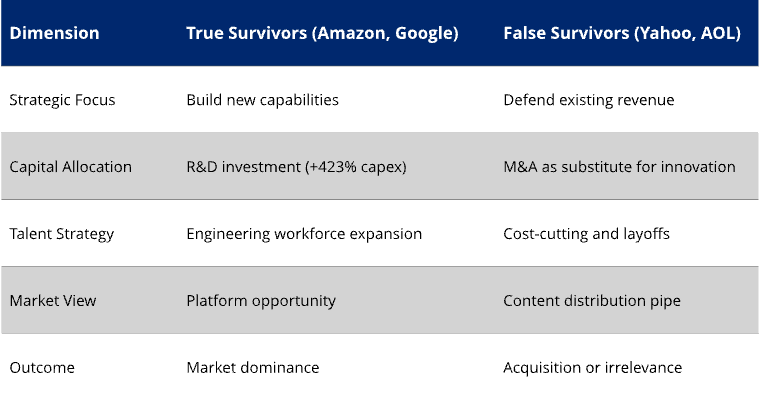
Source: SEC filings (Google S-1 2004, Amazon 10-K 2005)
Some insurtechs currently surviving may prove to be false survivors – still losing money, growing gross written premium without improving combined ratios, burning furniture to stay warm rather than building better engines. The metrics to watch: loss ratio trajectory, customer acquisition cost trends, whether the company is building capabilities or just cutting costs.
The Legacy Carrier Risk
Traditional retailers felt vindicated after the dot-com crash. Borders, Barnes & Noble, and Sears concluded that “the internet is a catalog, not a store.” They halted digital innovation. The “Amazon is just for books” fallacy prevailed. By the time the iPhone launched in 2007 and mobile commerce began, these incumbents were structurally incapable of competing.
Newspapers celebrated the death of digital advertising competitors. They coined the phrase “trading analog dollars for digital dimes” as justification to delay digitization. When ad spend began tipping online in 2005, they ignored the shift – believing their “premium content” would protect them. Revenue freefall began in 2008.
The incumbent pattern: disruption threat triggers panic (1998-2000), crash triggers relief (2000-2001), false confidence leads to strategy paralysis (2002-2005), surviving disruptors emerge with superior unit economics (2006+), incumbent cannot catch up. The timeline from celebration to existential threat: 5-10 years.
Legacy carriers celebrating insurtech failures risk the same trap. The first wave of insurtech may struggle, but the technology—telematics/IoT sensors, AI underwriting, embedded distribution – is valid. Root’s telematics model is now showing profitability improvements after fixing base rates and expense structure. Coalition’s AI-driven risk assessment produces loss ratios carriers cannot match. Shift’s fraud detection is becoming industry standard rather than optional add-on. The survivors are not taking massive market share – not yet. They’re cherry-picking high-margin segments: cyber, small commercial, tech-forward auto. The segments carriers find operationally expensive to serve.
If carriers pause digital transformation now, believing the “disruption” is over, they will be blindsided by mature insurtechs – or tech giant entries – within 3-5 years. The quiet period is the most dangerous time to relax.
The Investment Implication
If the insurtech timeline follows the dot-com timeline: 2025-2027 should see continued consolidation with survivors clarifying. 2028-2030 should see clear insurtech winners emerge at scale. 2032-2035 should see full return to 2021 funding levels with sustainable models. 2035-2040 should see legacy carriers face existential pressure as digital-native models achieve dominance in profitable segments.
The public market recovery has already begun. Root has risen from $3.46 to approximately $74 – over 2,000% from trough. Lemonade has recovered from $10.27 to approximately $82. These are early signals, not endpoints. The dot-com survivors took 7-15 years to reclaim peak valuations and then exceed them by orders of magnitude.
Capital allocation in P&C insurtech has undergone a structural shift toward B2B technology vendors. In Q1 2025, 61.4% of all P&C insurtech deals went to B2B companies – a stark reversal from 2019-2021, when consumer-facing full-stack carriers and distribution models commanded the majority of venture capital. Traditional momentum investors, the “tourists” – Tiger Global, SoftBank Vision Fund, and other generalist VCs – have largely exited insurtech following significant portfolio losses and strategic pivots. The remaining active investors are predominantly specialists and strategic corporate venture arms: MS&AD Ventures, Brewer Lane Ventures, ManchesterStory Group, Aquiline Capital Partners, and select insurance incumbents making selective bets. Munich Re Ventures, once a leading CVC player with $1.2 billion deployed, is winding down operations by mid-2026, further consolidating the shift toward specialized insurtech-focused investors. They’re conducting deep diligence on loss ratios and distribution costs. They’re accepting longer timelines.
The pattern recognition is straightforward. The crash was real. The destruction was extensive. But the survivors are building during the quiet period, just as Amazon and Google built during 2002-2005. The incumbents celebrating too early are positioning themselves for the same fate as Borders and newspapers.
The next Amazon is currently building in the dark. The next Borders is currently celebrating its survival.
Author Note: This analysis draws on publicly available academic research, industry data, and regulatory filings. Statistics are cited to primary sources where available.
AI Disclosure: Research compilation utilized AI tools to discover and verify publicly available data sources and citations. All analysis, interpretation, and conclusions are original work.