

Every conversation about economic development focuses on the same institutions: capital markets, infrastructure investment, trade policy, central banks. Insurance rarely makes the list.
This is a mistake.
Commercial property and casualty insurance operates as foundational infrastructure, as essential to economic development as roads, ports, and electrical grids. When businesses can transfer catastrophic risk to insurers, they invest, hire, and grow. When they cannot, economic activity contracts to what can be self-funded and self-insured.The global “protection gap” – the difference between total economic losses and insured losses exceeds $1.8 trillion annually. This gap represents unrealized economic potential: businesses that don’t form, investments that don’t occur, jobs that don’t exist. For investors who ask what good their capital does in the world, commercial insurance offers an unusually clear answer—and an unusual alignment between impact and returns.
The Risk Transfer Enablement Thesis
The relationship between insurance and economic development operates through a simple mechanism: risk transfer enables risk-taking.
Consider a logistics company contemplating expansion. Without adequate insurance, the owner faces the prospect of total business loss from a single catastrophic accident. The rational response is conservative operation: limited growth, minimal debt, constrained geographic reach. With proper coverage, the same owner can invest in additional vehicles, hire drivers, and expand routes, confident that a serious accident will not destroy the enterprise.
This mechanism operates across commercial sectors. Contractors require liability coverage to bid on construction projects; larger projects require larger limits. Equipment breakdown coverage enables capital investment in expensive manufacturing machinery. Errors and omissions coverage enables professional services firms to serve larger clients with greater exposure. Crop insurance enables farmers to plant higher-value crops and invest in land improvement. Commercial auto coverage enables fleet formation and operation.
The academic evidence supports these observations. Three competing hypotheses emerged in the literature on the insurance-growth nexus. The “supply-leading hypothesis” argues that insurance development precedes and causes economic growth. The “demand-following hypothesis” suggests insurance development is a consequence rather than cause of growth. But the “feedback hypothesis” has emerged as dominant. Insurance and growth reinforce each other in a virtuous cycle. Recent econometric studies using sophisticated approaches reveal this bidirectional relationship is non-linear, with mutual reinforcement strongest at early stages of development.
The practical implication: developing economies need not wait for growth to drive insurance development. Deliberate expansion of insurance infrastructure can accelerate growth, particularly in commercial lines where business investment decisions are directly conditioned on coverage availability.
Commercial Auto: The Circulatory System of Modern Commerce
Within commercial insurance, commercial auto occupies a unique structural position. In the United States, trucking moves approximately 72% of the nation’s freight tonnage and generates over $906 billion in annual revenue. The industry employs 8.4 million people, including 3.5 million truck drivers; more than any other single occupation in many states.
Commercial vehicles are not merely tools; they are the circulatory system of modern economies. Without functional commercial fleets, supply chains collapse. The COVID-19 pandemic illustrated this starkly: commercial trucking was classified as “essential infrastructure” because modern commerce literally cannot function without it.
Yet commercial auto insurance has operated in crisis for over a decade. The sector has posted combined ratios above 100%, meaning insurers pay out more in claims and expenses than they collect in premiums, in 12 of the last 13 years [1]. Commercial auto insurance premiums have increased for 55 consecutive quarters [1]. That’s nearly 14 years of uninterrupted price hikes affecting every business that operates vehicles.The traditional insurance industry has essentially one tool: raise rates across entire categories. If you’re a plumber with a perfect safety record, your rates still increase because other plumbers are filing claims. You’re punished for risks you didn’t create.
The Small Fleet Penalty
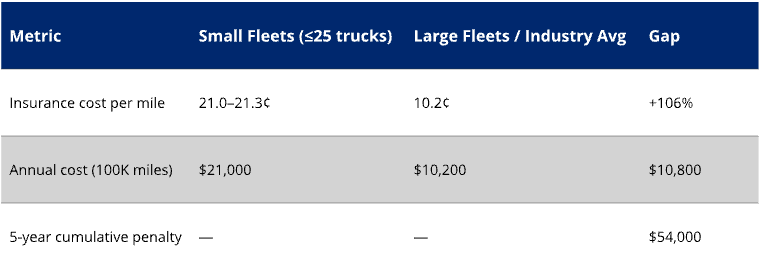
The most striking structural inequity in commercial auto insurance is what industry analysts call “the small fleet penalty.”According to American Transportation Research Institute data, small carriers pay approximately 21.0 – 21.3 cents per mile in insurance costs, compared to 10.2 cents for large carriers, a more than 100% penalty. This disparity exists because they do not have access to tools to manage risks to reduce insurance costs that larger fleets do. Without granular data, insurers default to pricing small fleets at the worst end of their category’s experience.
Table 1: Small Fleet Insurance Cost Penalty
Source: American Transportation Research Institute, Operational Costs of Trucking (2025)
The structural consequences are severe. An 11 cent per mile cost disadvantage erodes the margins necessary for small business growth. In down markets, large carriers survive on thinner margins while small carriers with high fixed insurance costs are forced to exit. The rate increase cycle becomes self-reinforcing: as small operators exit, the remaining pool becomes less competitive, inviting further rate increases.
For entrepreneurs attempting to build businesses through fleet ownership, this represents a structural barrier to wealth creation. The pathway from owner-operator to fleet owner requires capital accumulation. When insurance costs consume disproportionate margin, that accumulation becomes nearly impossible.
Proxy-Based Underwriting and Economic Mobility
Beyond the small fleet penalty, commercial auto insurers rely heavily on “proxy-based underwriting”—using variables that correlate with risk but may also embed socioeconomic biases.
Credit-based insurance scores represent the most consequential proxy. A Consumer Federation of America study found that good drivers with poor credit pay premiums 115% higher than good drivers with excellent credit in personal auto; similar dynamics apply commercially. Credit scores correlate with past economic circumstances, not driving ability. An entrepreneur who experienced financial hardship, job loss, medical emergency, economic disruption, carries that history into their insurance pricing regardless of how safely they operate their fleet.
Geographic rating compounds the effect. Garaging location affects premiums, and businesses in urban areas face higher base rates regardless of individual driving patterns. Experience requirements penalize new authorities and young businesses, creating surcharges that disproportionately affect entrepreneurs entering the market.
The cumulative effect: the insurance market systematically disadvantages economic mobility. Operators with established businesses, accumulated capital, and stable credit histories receive preferential pricing. New entrants, small operators, and entrepreneurs rebuilding from adversity face compounded penalties.
For social impact investors, this market structure represents both a problem and an opportunity.
The Telematics Solution: Pricing Behavior Instead of Demographics
Telematics, technology that monitors driving behavior, vehicle usage, and safety metrics, offers a mechanism to fundamentally restructure commercial auto insurance pricing.
The evidence base is unusually strong. There is a 20-30% crash reductions when telematics is properly implemented. Multiple controlled fleet trials and longitudinal evaluations find that telematics‑based monitoring and coaching found a 40-60% reduction in risky behavior like speeding and harsh braking when embedded in a structured safety program. Longitudinal studies show behavioral changes persist beyond initial adoption periods. Large-scale observational data validates the link between telematics-measured behaviors and actual crash outcomes.
Usage-based insurance utilizing telematics data can decouple rates from demographic proxies. The mechanism assesses risk based on actual driving behavior, speeding, hard braking, cornering, hours of service compliance, rather than credit scores or zip codes. A driver with a low credit score but excellent safety habits can prove their low-risk profile directly to the insurer, bypassing proxy variables that embed historical disparities.
Market examples validate the approach. Companies like Cover Whale focus on small fleets (1-25 units), provide dashcams and AI-driven coaching, and offer coverage to new ventures. HDVI offers “dynamic pricing” where monthly premiums adjust based on safety scores; case studies indicate fleets can save up to 30%.
For a single-truck owner-operator, the financial impact compounds meaningfully. For a truck running 100,000 miles a year, that’s an additional $11,000 in annual insurance costs that could be retained earnings through telematics-enabled cost reduction can pay down debt faster, provide down payment for a second truck, or create reserves preventing business failure during market downturns.
The Developing Market Opportunity
The protection gap is not evenly distributed. It concentrates in emerging markets where insurance penetration remains low despite expanding economic activity.
When a natural disaster strikes an uninsured economy, reconstruction requires diversion of development capital. When an uninsured business suffers a catastrophic loss, employees lose jobs without unemployment coverage, suppliers lose customers without accounts receivable protection, and communities lose tax base.
The relationship between income and insurance penetration follows predictable patterns. Economies with GDP per capita below $5,000 typically show less than 1% non-life insurance penetration. The critical transition occurs in the $5,000-15,000 range, precisely where many African and Asian economies now sit. This is the window of maximum impact for insurance market development.
Commercial lines have particular importance in developing economies. International investors require adequate local insurance capacity as a condition of investment. A World Bank analysis finds that countries with higher insurance penetration tend to have smaller infrastructure investment gaps, suggesting that a developed insurance sector can play a meaningful role in mobilizing long‑term capital for infrastructure.. Export-oriented businesses require credit insurance, marine cargo coverage, and trade credit facilities. Small and medium enterprises drive employment growth in developing economies, and commercial coverage requirements often serve as the trigger for formal registration, banking relationships, and regulatory compliance.
Africa: The World’s Largest Untapped Commercial Insurance Opportunity
The African insurance market represents the world’s largest untapped opportunity for commercial insurance development. As of 2024, the total market value reaches approximately $92.9 billion, projected to grow to $160.9 billion by 2033.
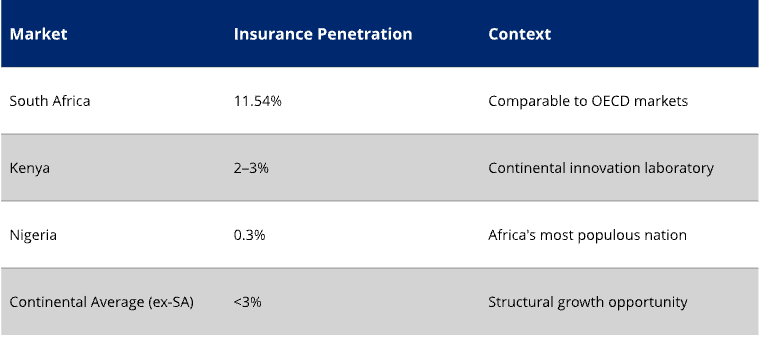
The structural challenge is stark: South Africa dominates, representing nearly 70% of continental premiums with a penetration rate of 11.54%, comparable to OECD markets. The rest of the continent offers structural growth potential with penetration rates rarely exceeding 3%. Nigeria shows approximately 0.3% penetration despite being Africa’s most populous nation. Kenya operates at approximately 2-3%, depending on the year and source, serving as the continental innovation laboratory.
Table 2: African Insurance Market Penetration
Source: Swiss Re, KPMG Insurance in Africa Report
Technology is transforming insurance access in these markets. Mobile money platforms enable premium collection without banking infrastructure. Parametric products pay automatically when defined triggers occur without requiring loss adjustment infrastructure. Alternative data underwriting uses mobile phone usage patterns, utility payment history, and satellite imagery to provide risk assessment where traditional sources are unavailable.
Commercial auto in Africa presents unique dynamics. South Africa leads telematics adoption with 2.3 million units installed in 2023, projected to reach 3.8 million by 2028. Companies like Karooooo (formerly Cartrack) and Netstar are expanding northward. Starlink and other satellite providers are solving connectivity infrastructure challenges that previously limited telematics deployment outside major urban centers.
For impact investors seeking structural growth opportunities, African commercial insurance development represents a multi-decade trajectory with compounding returns and measurable development impact.
Why Impact and Returns Are Aligned
The critical insight for social impact investors: in commercial auto insurance, impact and returns move in the same direction.
The mechanism is straightforward. Telematics identifies safer drivers, which generates lower claims costs, which produces better margins. Lower premiums for good risks create competitive advantage, which drives market share growth. Safer fleets mean fewer accidents, which saves lives.
Insurance companies with superior risk selection consistently outperform those that simply price for expected catastrophe. Impact doesn’t sacrifice returns, it generates them.
This is not a situation where impact is a separate department running philanthropic programs alongside the profit center. The same data that improves safety outcomes improves underwriting margins. The metrics that demonstrate impact, accident reduction, behavior change, are the same metrics that demonstrate underwriting performance. If accidents don’t decrease, claims costs don’t decrease. If claims costs don’t decrease, margins suffer.
Unlike many impact investments where outcomes are hard to measure or take decades to materialize, telematics-enabled insurance produces measurable results within months: fewer harsh braking events, reduced speeding, lower accident rates. The feedback loop is tight enough to demonstrate causation, not just correlation.
The Scale of Potential Impact
The potential scale merits consideration:
If telematics achieves a 25% reduction in the 5,000+ annual U.S. commercial vehicle deaths, that’s 1,250+ lives saved per year. Apply similar reductions to the 70,000+ injuries, and 17,500+ people are spared serious harm annually.
Closing the more than 100% cost gap for small fleets represents billions in annual savings industry-wide. That capital, retained by small business owners instead of extracted by insurers, compounds into business equity.
The $1.8 trillion global protection gap represents an equivalent scale of unrealized economic potential: businesses that could form, investments that could occur, jobs that could exist if insurance infrastructure developed appropriately.
A Narrative Worth Telling
For investors evaluating impact investments, the insurance sector offers a story that resonates:
“We invested in a company that makes roads safer by using data to identify and reward good drivers. The traditional insurance industry just raises everyone’s rates when accidents increase. This approach actually prevents accidents and the data proves it works. Along the way, it gives small business owners a fair shot at affordable insurance based on how they actually drive, not their credit score or zip code. The business model aligns incentives: safer fleets mean fewer claims, which means better margins. Impact and returns move in the same direction.”
The combination of immediate measurability, clear attribution, and incentive alignment makes commercial auto insurance unusually well-suited for impact investors who want accountability, not just aspirations.
What This Research Implies
The evidence synthesized here points to specific characteristics that would define an effective telematics-enabled commercial auto insurance model:
Risk Selection: The ability to identify safer-than-average risks within categories that traditional insurance prices as homogeneous pools. The more than 100% cost penalty for small fleets exists because the market lacks risk management and cost reduction tools for small fleets.
Loss Prevention: Active engagement in reducing accidents, not just pricing for expected losses. The research is clear that passive telematics, hardware without feedback, produces negligible safety improvement. Effective models require closed-loop systems with real-time feedback and coaching.
Accessible Pricing: Mechanisms to serve markets that traditional insurance has effectively abandoned through pricing. Small fleets, new entrants, and entrepreneurs rebuilding from adversity face structural barriers that telematics can address by replacing proxy-based underwriting with behavior-based assessment.
Measurable Outcomes: Commitment to tracking and reporting impact metrics, not as a marketing exercise, but as core operational data.
The mechanisms described are not U.S.-specific. Telematics technology is globally deployable. The small fleet penalty exists wherever insurance markets rely on class-based rather than individual pricing. Developing markets with low insurance penetration represent structural growth opportunities.
Commercial property and casualty insurance rarely appears in discussions of economic development infrastructure. The evidence suggests it should.
Author Note: This analysis draws on publicly available academic research, industry data, and regulatory filings. Statistics are cited to primary sources where available.
AI Disclosure: Research compilation utilized AI tools to discover and verify publicly available data sources and citations. All analysis, interpretation, and conclusions are original work.
Endnotes
[1] Indenseo Research analysis.