

Follow the money, and the pattern becomes unmistakable.
Between 2020 and 2025, private equity firms deployed over $150 billion into the insurance industry. Apollo completed its $29 billion merger with Athene. KKR acquired Global Atlantic and grew assets from $72 billion to $158 billion within three years. Aon paid $13.4 billion for NFP. PE-backed buyers completed 70-73% of all insurance agency M&A transactions during this period, with purchase multiples expanding from 13.1x to 16.7x EV/EBITDA.
The money flowed decisively into life insurance, insurance distribution, and specialty lines. What did PE systematically avoid? Commercial auto insurance carriers. Despite representing a substantial segment of the global P&C market, $199.9 billion in premiums (US market – $72 billion) and growing, research reveals “extremely limited direct PE acquisition activity in commercial auto insurance carriers or fleet insurance specialists” during the entire period.
This revealed preference tells us something important about how PE approaches insurance. Not because PE lacks capital or appetite for insurance; clearly it has both. But because some markets can be optimized through financial engineering, while others require something PE isn’t structured to deliver: genuine operational transformation.
Understanding this distinction is essential for any investor evaluating insurance opportunities.
Private Equity Investment Pattern - Where the Money Went
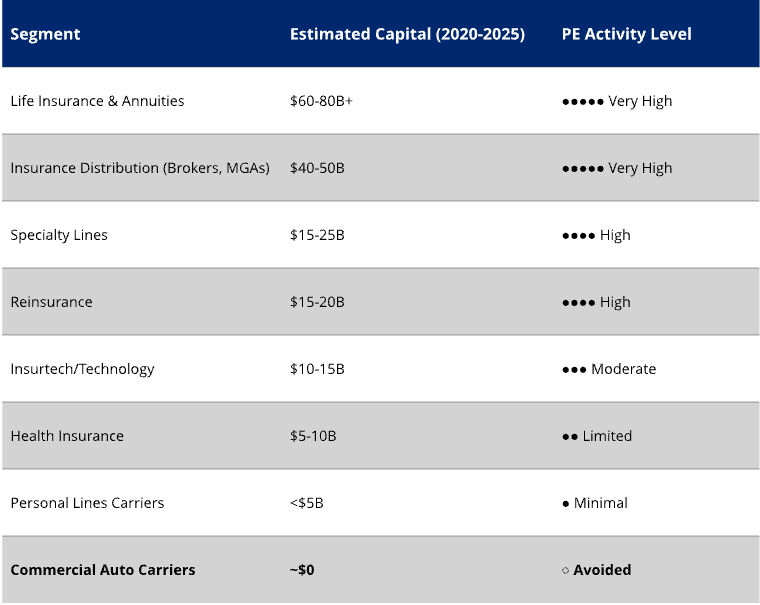
Sources: PitchBook, NAIC Capital Markets Bureau, S&P Global Market Intelligence, Indenseo Research
The Private Equity Insurance Playbook
Private equity’s insurance thesis is straightforward and well-articulated. Insurance provides predictable, long-duration liabilities that create stable capital for credit investments. PE-owned life insurers invest more heavily in alternative assets, $42.9 billion in Schedule BA investments at year-end 2024, up 17% from the prior year. The spread between what insurers pay policyholders and what they earn on invested assets generates returns that justify the acquisition premium.
The thesis works in life insurance and annuities because the transformation required is primarily financial. PE firms excel at asset-liability optimization, regulatory arbitrage through reinsurance structures, and deploying insurance float into higher-yielding credit investments. These are financial engineering competencies that transfer directly from PE’s core skillset.
Insurance distribution attracts PE for similar reasons. Brokerages generate predictable recurring commission revenue, 60-80% from renewals, with EBITDA margins of 25-35%. The transformation required is operational efficiency: consolidating back offices, implementing common technology platforms, and achieving purchasing scale. These are the rollup economics PE has perfected across dozens of industries.
But examine the leadership PE installs in its insurance platforms, and a pattern emerges. The executives running PE-backed insurance companies overwhelmingly come from legacy carrier backgrounds. This makes intuitive sense – PE firms want “industry expertise” and “credibility with regulators and rating agencies.” But it also reveals something about PE’s approach to insurance investment.
PE firms hire legacy executives because they’re satisficing for familiarity rather than optimizing for transformation. They want someone who knows the regulatory environment, has relationships with reinsurers and rating agencies, and can execute the financial engineering playbook without requiring the PE partners to deeply understand insurance operations. This is rational given PE’s business model, but it has consequences.
The consequence is that PE imports the same mental models and operational assumptions that created the problems in the first place. When your leadership comes from organizations that have struggled with technology integration for decades, you get the same technology struggles. This isn’t criticism of the executives, they’re executing what they know. It’s an observation about what the hiring pattern reveals about PE’s theory of change.
Satisficing at Every Level
Herbert Simon received the Nobel Prize in Economics for describing how organizations actually make decisions. His central insight: they don’t optimize. Instead, they “satisfice”, a portmanteau of “satisfy” and “suffice” describing the tendency to accept options that meet a minimum threshold rather than searching for the best option.
Optimizing requires identifying all possible alternatives, determining all consequences, and selecting the single alternative that maximizes the objective function. Satisficing sets an aspiration level, searches sequentially, selects the first alternative that meets the threshold, and stops immediately.
As I explored in a recent Carrier Management article on human capital efficiency, the satisficing framework explains organizational behavior that otherwise seems irrational. Companies acknowledge problems, commission studies, launch initiatives and change almost nothing. They’re not failing to execute. They’re executing exactly what their incentive structures reward: acceptable outcomes rather than optimal ones.
The PE approach to insurance investment exhibits satisficing at every level of the stack.
At the thesis level, PE frames insurance opportunities as financial arbitrage rather than operational transformation. The stated goal is to generate “spread-related earnings” and “regulatory and investment alpha,” as articulated in Brookfield’s 2025 Investor Day presentation and Athene’s investor presentations. This is satisficing on the financial metrics that LPs measure: IRR, multiple on invested capital, distributions, rather than optimizing for sustainable competitive advantage.
At the talent level, PE hires legacy carrier executives who can execute the financial playbook without requiring PE partners to deeply engage with insurance operations. This satisfices for familiarity and relationship continuity rather than optimizing for transformation capability.
At the infrastructure level, PE portfolio companies make technology choices optimized for exit rather than operational performance. Standard technology stacks, Microsoft enterprise environments, established core systems, familiar vendor relationships, reduce due diligence complexity for the next buyer. This satisfices for transaction convenience rather than optimizing for competitive differentiation.
At the timeline level, PE fund structures create inherent misalignment with transformation horizons. A typical PE fund has a 10-year life with 5-year investment periods and expectations of 3-5 year hold periods per investment. Genuine operational transformation in regulated industries: building technology platforms, achieving regulatory approvals, changing customer behavior, typically requires 7-15 years. Fund timelines satisfice for LP liquidity expectations rather than optimizing for transformation outcomes.
Financial Engineering vs. Operational Transformation
Financial engineering works when the underlying business generates acceptable returns that can be amplified through capital structure optimization, operating leverage, and multiple arbitrage. The PE playbook, acquire at 8x, improve margins 200 basis points, exit at 10x, works when the business is already profitable and the transformation required is primarily about efficiency rather than reinvention.
Operational transformation is different. It requires changing how an organization actually works: the technology architecture, the talent composition, the operational workflows, the customer relationships. It often requires sustained investment through periods of negative returns before improvement materializes. And it requires leadership that understands the operational domain deeply enough to make non-obvious decisions.
The distinction explains where PE succeeds in insurance and where it systematically avoids participation.
Life insurance works for PE because the transformation is primarily financial. The underlying product, long-duration liabilities, is well-understood. The operational complexity is in asset-liability management and regulatory optimization. PE firms can add value through superior investment management and capital efficiency without fundamentally changing how insurance is produced and delivered.
Distribution works for PE because the transformation is primarily operational efficiency at scale. The underlying economics, commission revenue on policy placement, are proven. PE can add value through back-office consolidation, purchasing leverage, and technology standardization. The transformation required doesn’t challenge the fundamental business model.
Commercial auto insurance requires something different. Twelve out of thirteen years of underwriting losses. Combined ratios above 100% despite 55 consecutive quarters of rate increases. The problem isn’t capital, the industry has plenty. The problem isn’t pricing, carriers have tried sustained rate increases without achieving profitability. The problem isn’t awareness, every rating agency, consultant, and industry analyst has documented the challenges.
What if the problem isn’t capital? What if it’s approach?
Commercial Auto: A Market Requiring Transformation
Commercial auto insurance presents a case study in transformation requirements that financial engineering cannot address.
Consider the mathematics. Commercial auto has recorded combined ratios above 100% for 12 of the past 13 years, meaning insurers have paid out more in claims and expenses than they earned in premiums, year after year. Commercial auto liability alone posted a $6.4 billion underwriting loss in 2024, according to AM Best. This isn’t a temporary dislocation. It’s a persistent structural condition that has resisted every conventional remedy the industry has attempted.
Commercial Auto Insurance Combined Ratio (2012-2024)
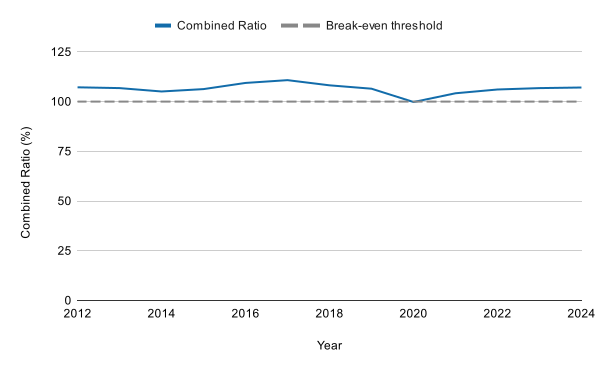
2020 – pandemic year – only profitable year in 13
Source: AM Best, NAIC, Indenseo Research
The structural challenges are well-documented: social inflation driving nuclear verdicts (median $23.8 million in 2023), vehicle repair cost inflation from advanced technology components that cost thousands to replace, acute driver shortages affecting both loss frequency and fleet operations, and deteriorating road infrastructure that contributes to accident severity. These aren’t cyclical problems that resolve through pricing discipline. They’re structural conditions requiring operational innovation.
AM Best maintains a Negative outlook on commercial auto, noting that the segment “struggles with a combined ratio that has been consistently over 100% despite rate increases.” S&P Global projects the commercial auto combined ratio will slowly deteriorate from 104.4% in 2026 to 106.3% by 2029, no return to profitability within the medium-term horizon.
The technology disconnect is particularly instructive. While 77% of commercial fleets use telematics systems, only 40% of insurers use that data in underwriting decisions. And here’s the revealing statistic: 70% of fleet managers report they don’t share telematics data with insurers, and 79% said they’ve simply never been asked.
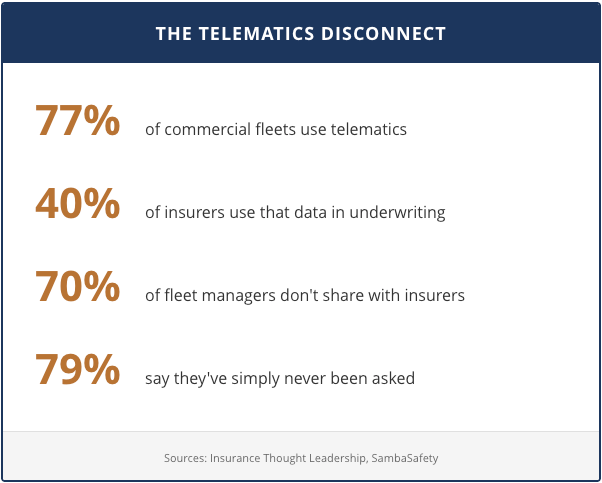
This isn’t a technology problem. The hardware works. The data exists. The fleets are willing partners. As I detailed in Why Insurance Telematics Integrations Fail in Carrier Management, the barriers are operational: legacy IT architectures that can’t ingest real-time data, workflow processes that don’t incorporate telematics insights, and organizational structures that fragment responsibility across underwriting, claims, and risk management silos.
Digital transformation projects in insurance carry failure rates exceeding 70%. The failure mode is consistent: technology implementations are approached as IT projects rather than operational transformations. Organizations buy new tools and try to bolt them onto unchanged workflows, the “Ferrari engine in a covered wagon” pattern that produces expensive disappointments rather than competitive advantage.
Solving commercial auto requires changing how risk is assessed, priced, and managed, not just adding technology to existing processes. It requires leadership with deep operational understanding of both insurance and the fleet ecosystem. It requires patient capital willing to support multi-year transformation without pressure for near-term exits.
PE’s revealed preference, systematically avoiding commercial auto carrier investments, suggests recognition that the playbook doesn’t fit. This isn’t a criticism of PE decision-making. It’s rational given PE’s business model and success metrics. But it reveals the boundaries of financial engineering as an approach to value creation.
The Structural Mismatch
The performance data raise questions about PE’s value proposition even in segments where the playbook theoretically applies.
The Kauffman Foundation’s analysis of its own venture and PE portfolio, one of the most comprehensive institutional self-assessments ever published, found that 62% of funds failed to exceed returns available from public markets after fees were paid. A January 2024 Harvard Business School working paper examining PE performance in the post-Global Financial Crisis era concluded that “the average or median PE funds do not actually outperform their PMEs since the GFC”.
These findings don’t suggest PE creates no value, top-quartile funds do outperform, and the dispersion between top and bottom quartile is substantial (14-18% annually). But they challenge the assumption that PE as an asset class systematically outperforms public alternatives after accounting for fees, illiquidity, and risk.
The fee structure matters for insurance investors specifically. The standard 2-and-20 model – 2% annual management fees plus 20% carried interest on profits -compounds to significant value extraction over fund life. Academic research estimates that fees consume 5-8% of annual gross returns, transforming potential outperformance into mediocrity or underperformance for many funds.
For insurance investments with long transformation horizons, this fee drag becomes particularly problematic. A 10-year transformation generating 15% gross returns might deliver only 8-10% net to LPs after fees; barely competitive with public market alternatives and substantially below what LP expectations require to justify the illiquidity premium.
The question isn’t whether PE firms are competent, they clearly are within their domain. The question is whether the PE model aligns with the requirements of specific insurance opportunities. When the playbook fits, financial engineering, operational efficiency, rollup economics, PE has demonstrated ability to create value. When the opportunity requires something different, patient capital, deep operational transformation, timeline horizons beyond fund life, the structural mismatch becomes limiting.
Implications for Different Investor Types
This analysis suggests different frameworks for different investor categories evaluating insurance opportunities.
For institutional LPs allocating to PE funds: Selectivity matters more than access. The wide dispersion between top-quartile and bottom-quartile performance (14-18% annually) means manager selection determines outcomes more than asset class allocation. The data suggest that PE as an asset class doesn’t systematically outperform public markets, individual manager skill and strategy fit determine returns. For LPs without access to consistently top-performing managers, the case for PE allocation weakens considerably relative to indexed alternatives.
For family offices considering direct insurance investment: The shift from intermediated to direct deployment may offer structural advantages in insurance. Family offices have increased direct investments to 17% of portfolios while fund investments decreased to 10%, a revealed preference suggesting those who can choose are increasingly choosing to bypass traditional fund structures. Co-investment programs at large institutional investors report net IRRs around 27% versus approximately 19% for traditional primary fund commitments, a differential driven largely by eliminating the fee structures that erode returns.
Patient capital with longer time horizons can support transformation timelines that fund structures cannot accommodate. The economics are particularly compelling for opportunities that require 7-15 year development periods, timelines that create structural misalignment with standard PE fund lives but align naturally with family office investment horizons.
For strategic investors and carriers: The PE playbook’s limitations in transformation-requiring segments may create opportunity for different approaches. Markets like commercial auto, systematically avoided by PE despite their scale, might reward operators with technology-first capabilities, patient capital backing, and willingness to pursue multi-year transformation without exit pressure. The infrastructure that PE finds unsuitable for their model may be precisely what creates sustainable competitive advantage for operators with different capital structures.
For entrepreneurs and operators in insurance: Capital structure matters as much as capital access. Raising PE fund capital for a transformation opportunity creates structural misalignment from day one, the fund’s timeline requirements will pressure decisions that may undermine long-term value creation. The insurance industry has seen this pattern repeatedly: PE-backed insurtechs achieving rapid growth metrics while destroying economic value, then failing when the underlying unit economics never materialized.
Matching capital structure to business characteristics isn’t about ideology, it’s about setting up conditions for success. Some opportunities genuinely fit the PE model and benefit from PE’s operational playbook and value-creation capabilities. Others require patient capital, and raising the wrong type of capital is itself a form of satisficing, accepting the first funding that meets the minimum threshold rather than optimizing for the capital structure that maximizes probability of success.
The framework isn’t “PE bad, alternatives good.” It’s more nuanced: different capital structures fit different opportunities. PE’s approach works where financial engineering and operational efficiency create value on fund-life timelines. It doesn’t fit where genuine transformation requires patient capital and deep operational commitment.
The Revealed Preference
Private equity’s insurance investment pattern over the past five years reveals both capabilities and limitations. The $150+ billion deployed into life insurance, distribution, and specialty lines demonstrates PE’s genuine appetite for the sector and ability to create value where the playbook fits.
The systematic avoidance of commercial auto carriers, despite the segment’s substantial size and obvious transformation potential, reveals the boundaries of that playbook. PE firms are sophisticated enough to recognize when opportunities don’t fit their model. They’re rational in declining to pursue investments requiring capabilities and timelines their fund structures can’t support.
For investors evaluating insurance opportunities, the analysis suggests moving beyond capital availability as the primary consideration. The insurance industry has access to substantial capital across PE funds, family offices, reinsurance relationships, and public markets. Capital isn’t the scarce resource.
What’s scarce is alignment between capital structure, transformation timeline, and operational capability. Markets requiring genuine transformation, not just financial optimization, need investors willing to match their approach to the actual requirements of value creation.
The question for any specific insurance opportunity isn’t whether capital is available. It’s whether the capital’s structure, timeline expectations, and operational engagement model match what the opportunity actually requires.
Different answers lead to different outcomes.
Author Note: This analysis draws on publicly available academic research, industry data, and regulatory filings. Statistics are cited to primary sources where available.
AI Disclosure: Research compilation utilized AI tools to discover and verify publicly available data sources and citations. All analysis, interpretation, and conclusions are original work.
This analysis is part of an ongoing series examining private equity’s approach to insurance investment and what revealed preferences tell us about market structure and opportunity