

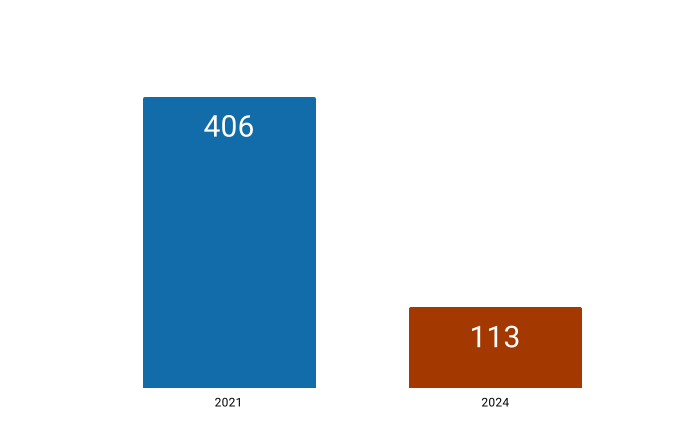
The most telling signal in insurance today isn’t a demo; it’s a capital flow. Our research reveals the number of active investors repeatedly backing insurtech deals fell 72% in just three years – dropping from 406 active investors in 2021 to merely 113 in 2024 [1]. This isn’t a cyclical downturn or a “wobble.” It is a structural realignment. We’ve found this collapse stems from a fundamental mismatch: classic 10-year VC fund clocks simply do not match the 7–10 year build cycles required for insurance transformation [2].
The VC Exodus: A 72% Drop in Active Investors
The number of active investors repeatedly backing insurtech deals fell from 406 in 2021 to 113 in 2024
Source: CB Insights
The VC Exodus: A Failure of Capital Structure
Capital timelines broke product timelines. VCs discovered that even breakthrough technology can’t overcome the reality that insurance products need 3-5 years of actuarial data to achieve statistical credibility – a timeline that breaks their fund economics [2],[11]. This created a “valley of death” for scaling companies that had product-market fit but hadn’t yet proven loss-ratio impact.
When pitching the investment opportunity, a pattern emerged. Even supportive VCs admitted the capital environment was brutal. The market signal was clear: top-tier investors who had previously backed insurtech had soured on the sector after a string of disappointing returns. Counterintuitively, we found that VCs with prior insurtech investments weren’t a source of “smart money”; they were a source of “scar tissue.” They were less likely to take a meeting, not more.
These aren’t failures of innovation; they are failures of capital structure alignment
Consider the wreckage: Root Insurance’s valuation collapsed over 80% post-IPO [4]. Metromile, once valued at $1.3 billion, sold for a 61% loss [4]. Total insurtech losses between 2015-2020 exceeded $10 billion. These aren’t failures of innovation; they are failures of capital structure alignment.
The commercial auto insurance market crystallizes this problem.
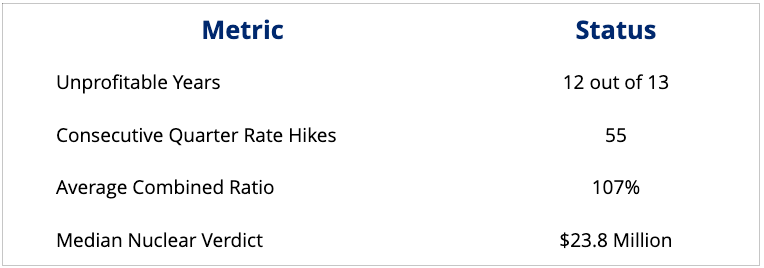
The Commercial Auto Crisis: Key Metrics
The market has been unprofitable for 12 out of 13 years, with combined ratios consistently over 107%
Source: Insurance Journal, S&P Global
The line has been unprofitable for 12 out of 13 years [3]. Despite 55 consecutive quarters of rate hikes, combined ratios remain consistently above 107%, indicating a loss on every policy written [9]. Carriers still face nuclear verdicts averaging $23.8 million [3]. This is a market that requires patient capital to implement real solutions, but VCs, facing pressure for exits by year seven, have run out of patience and retreated.
The Patient Capital Revolution
Family offices are stepping into this void with a fundamentally different calculus. Managing between $5.5 and $10 trillion globally, they now provide 31-40% of global startup capital [2]. Unlike VCs facing fund expiration dates, they operate with permanent capital structures and multi-generational investment horizons. Our research identifies critical advantages they bring.
First, permanent capital and pacing. They can fund the 24-36 months of “data flywheel spin-up” and support companies through the complete 50-state regulatory approval cycle – a process that can cost $5-10 million before generating revenue [5].
Second, flexible value capture. They can capture value through multiple paths beyond a traditional exit: dividend distributions from profitable underwriting, partial strategic sales, and permanent hold strategies. The economics are compelling: by eliminating the 2-and-20 fee structure, they improve net returns by 300-500 basis points annually [5].
Third, and most importantly, operator-first governance. The dominant failure mode in insurtech was elegant technology without domain control. Family offices can enforce a “boring infrastructure first” agenda – focusing on policy admin, ingestion pipelines, and data governance. They can buy undervalued assets, layer in AI, and compound value by capturing loss-ratio improvement over years, not quarters.
The AI-Native Blueprint
The convergence of family office capital with artificial intelligence creates conditions we haven’t seen since the early internet era. AI has fundamentally altered insurance economics in ways that make family office investment timelines optimal.
Consider the transformation in underwriting costs: our analysis shows AI-powered systems can reduce processing from $1,090 per application to just $10 – a 109x improvement [5]. More dramatically, frontier AI training costs have collapsed by over 90% – with models like DeepSeek-V3 trained for $5.6 million, not $100 million – while inference costs have dropped over 280-fold since 2022 [10].
This catalyst shifts the entire competitive landscape. The infrastructure barriers that previously protected incumbents are crumbling. Our data indicates 70% of incumbent carriers’ digital transformation initiatives fail [6], primarily because they are attempting to modernize mainframe systems from the 1970s and 1980s [8].
With open-source models collapsing experimentation costs, advantage is migrating from “better algorithms” to better data, workflows, and distribution. The moat is now access to high-frequency, high-relevance data. Every telematics agreement, for example, needs explicit language on permissible uses, retention, and derivative analytics. AI also enables entirely new products: parametric coverage triggered by sensor data, dynamic pricing adjusted in real-time, and automated claims processing that reduces settlement time by 75% [7].
A Pragmatic Playbook for Patient Capital
For family offices ready to own this cycle, sequence matters. A pragmatic operator’s path involves six steps.
First, pick the wedge: Start where lift is measurable, like commercial auto programs with telemetry or specialty lines with dense operational data.
Second, acquire the pipes: Buy or partner with an integration shop that already aggregates multi-TSP feeds. Without the plumbing, AI is just theater.
Third, control the loss ratio, then the premium: Begin as an enablement layer (software + analytics). As the signal stabilizes, step into MGA authority, then add risk capital through a fronting/reinsurance stack.
Fourth, set capital-efficiency guardrails: Insist on the AI-native spend profile-milestone-gated tranches and shared savings, not blank checks.
Fifth, govern by outcomes: Track combined ratio trend, adjudication cycle time, and exoneration rate – not vanity ARR.
Finally, design for permanence: Build compliance, data governance, and model documentation from day one. It lowers audit friction and increases take-out value whether you sell, roll up, or hold.
Expect fewer loud brands and more “boring infrastructure” – quiet operators that own data rights, underwriting pipes, and claims muscle. Family offices that combine control deals with enablement platforms will compound value as the old stack finally gives way. Do the unglamorous work early and compound. That’s how durable moats form.
Endnotes
[1] CB Insights, State Of Insurtech Q4’23 Report, 2024. As cited in The Global Telematics & Sensor Data Market (Indenseo Research, 2025).
[2] Indenseo Research, Family Office Investment in Insurtech, 2025.
[3] Insurance Journal, Commercial Auto Combined Ratio Analysis, 2024; Conning, 2025 Commercial Auto Study, 2025.
[4] Fortune, “Root Insurance Post-IPO Performance Analysis,” 2023; TechCrunch, Metromile Acquisition Analysis, 2022.
[5] Indenseo Research, AI Impact on Insurance Operations, 2025; McKinsey & Company, InsurTech Capital Requirements Study, 2024.
[6] McKinsey Digital, Digital Transformation Failure Rate, 2024. As cited in The Global Telematics & Sensor Data Market (Indenseo Research, 2025).
[7] Accenture, AI in Insurance Underwriting, 2024; Deloitte, Insurance Innovation Report, 2024.
[8] Gartner, Insurance IT Budget Analysis, 2024.
[9] S&P Global, Commercial Auto Insurance Performance, 2025.
[10] Stanford University, 2025 AI Index Report, 2025; DeepSeek AI, DeepSeek-V3 Technical Report, 2024.
[11] Insurance Information Institute. Commercial Insurance Market Dynamics. III, 2024
Author Note: This analysis draws on publicly available academic research, industry data, and regulatory filings. Statistics are cited to primary sources where available.
AI Disclosure: Research compilation utilized AI tools to discover and verify publicly available data sources and citations. All analysis, interpretation, and conclusions are original work.