
This Market Intelligence briefing will be exclusive for paid subscribers 90 days after the publication date. This analysis extends the Optimized Satisficing thesis (February 2026) into the capital structure mechanics underneath carrier AI deals and the Physical AI paradigm those deals cannot address.
Key Signals
PE-backed AI consulting ventures (DeployCo at $10B, Anthropic/Blackstone at $1.5B) are capital-structure confessions: the model alone cannot generate the enterprise revenue these companies need. The guaranteed 17.5% return to PE sponsors is a fixed-yield credit instrument, not a technology bet.
Model commoditization is accelerating faster than Moore’s Law (50x annual inference cost decline), but a 643x pricing spread between commodity and frontier tiers allows consulting intermediaries to steer carriers toward expensive contracts when 85% of workloads could run at 1/50th the cost.
Every major carrier AI deal targets the same thing: optimization of existing workflows through existing data. None address sensor integration, edge inference, or the Physical AI data layer where new insurance products will be designed.
The edge AI chip market is scaling toward $57.8 billion by 2034. Emerging-market insurers are already operating sensor-to-payment architectures (weather stations to M-Pesa, telematics to usage-based pricing) that have no natural entry point for the LLM consulting layer.
The execution gap is real: Path 1 deals consume the budget, engineering bandwidth, and board attention that Path 3 (Physical AI) would require. The trap is not that optimization is wrong. It is that optimization crowds out transformation.
1. The Confessions
On May 4, 2026, OpenAI finalized a $10 billion deployment venture called DeployCo with TPG, Brookfield, Bain Capital, Advent International, and fifteen additional private equity partners. The same day, Anthropic announced a parallel venture with Blackstone, Hellman and Friedman, and Goldman Sachs, capitalized at $1.5 billion. Zero investor overlap between the two ventures. Both announced within 36 hours.
These are not product launches. They are capital-structure confessions: the model alone cannot generate the enterprise revenue these companies need. They are also distribution confessions. Neither OpenAI nor Anthropic controls the surfaces through which enterprises access their products. Approximately 60% of OpenAI’s enterprise revenue flows through Microsoft Azure. Seventy-five percent of Anthropic’s API revenue flows through indirect channels: Amazon Bedrock, Google Vertex, and tools like Cursor. Anthropic’s CFO has acknowledged that partnerships are central to the company’s distribution strategy. When three-quarters of your revenue depends on platforms controlled by companies building competing models, a PE-backed consulting venture is not a growth strategy. It is a manufactured distribution channel.
DeployCo is a Delaware LLC led by OpenAI COO Brad Lightcap. OpenAI committed $500 million in initial equity with a $1 billion option to scale. The PE sponsors contributed $4 billion. The structure includes a guaranteed minimum annual return of 17.5% to PE backers over a five-year commitment -- more than double the industry-standard 8% preferred return. OpenAI retains control through super-voting shares. The PE sponsors have no governance power over model training or strategy. The investors backing a $10 billion AI deployment venture have no say in how the AI works. They have a guaranteed return. Section 6 examines what that return structure means for the enterprises on the receiving end.
Read that again. The investors backing a $10 billion AI deployment venture have no say in how the AI works. They have a guaranteed return. This is a fixed-yield credit instrument wearing a technology venture’s clothes.
Anthropic’s venture follows a different governance structure but identical logic. Public financial disclosures from the venture’s launch confirm the equity breakdown: Anthropic, Blackstone, and Hellman and Friedman each committed $300 million as individual anchor investments. Goldman Sachs and General Atlantic each committed $150 million, with GIC and additional participants bringing total capitalization to approximately $1.5 billion. The venture targets heavily regulated, document-dense financial verticals: investment research, underwriting analysis, compliance monitoring, fraud investigations. Anthropic reports that 40% of its top 50 customers are financial institutions, a figure disclosed at its “The Briefing: Financial Services” event in New York on May 5, 2026.
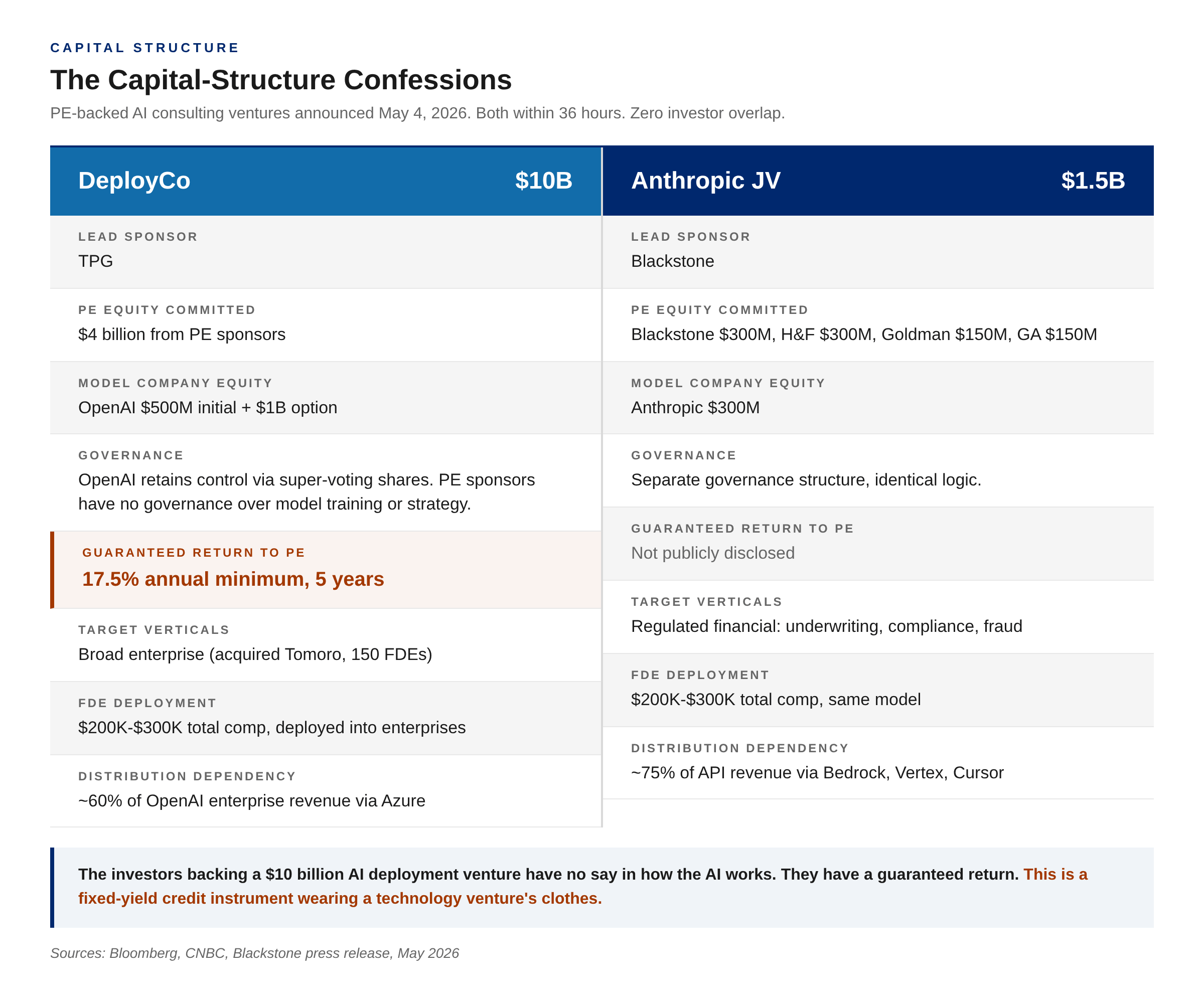
Both ventures deploy Forward Deployed Engineers at $200,000 to $300,000 total compensation into enterprises that cannot operate the software without them. DeployCo immediately acquired Tomoro, an applied AI consulting firm, bringing approximately 150 FDEs and active accounts including Tesco, Virgin Atlantic, Mattel, and Red Bull. The FDE model is not new. Palantir pioneered it a decade ago. Palantir’s stock has returned roughly 640% since its 2020 public listing, driven significantly by this model. The economics work for the vendor because the enterprise cannot evaluate whether the deployment succeeded. It is a credence good: the buyer lacks the expertise to assess quality, so the seller defines the terms of engagement and renewal.
The market understood the signal within days. On May 12, Indian IT outsourcers dropped sharply as investors priced in the structural threat: TCS dropped 3.8%, HCLTech fell 4.1%, Infosys fell 3.1%, and the Nifty IT index lost 7% over the following four trading sessions. The index had already shed more than 40% from its December 2024 peak. The market read these ventures as a structural claim that human deployment engineers, not autonomous AI, will be the revenue engine for enterprise AI adoption.
Both companies launched PE-backed consulting ventures within 36 hours. That timing is not coincidental. It is a coordinated market signal that neither company’s model revenue alone can sustain the growth trajectory their valuations require.
2. What Carriers Are Buying
The insurance carrier AI deal landscape is large, growing, and remarkably uniform in what it purchases.
Nationwide committed $1.5 billion to technology modernization through 2028, with 20% allocated to scaling AI. The deployments target underwriting guideline analysis, commercial submission summarization, and service request processing. State Farm joined as a launch partner for OpenAI’s Frontier platform, building what it calls “AI coworkers” for agents and claims. Liberty Mutual deployed LibertyGPT to 45,000 employees through OpenAI, achieving approximately 25% adoption and saving an estimated 17,000 administrative hours per week. Travelers equipped roughly 10,000 engineers and analysts with personalized Claude assistants; its claims contact center staff has been reduced by a third. AIG built an enterprise ontology integrating more than four million data points through Palantir Foundry and launched a Lloyd’s syndicate with Amwins and Blackstone with $300 million in initial stamp capacity.
In Europe, the numbers are larger. Allianz posted record operating profit of EUR 4.5 billion in Q1 2026 while registering more than 900 AI use cases; employees built 30,000 custom AI agents on the AllianzGPT platform serving 60,000 workers. Generali backed its “Lifetime Partner 27” strategy with an approximately EUR 1.3 billion technology and digital transformation fund. Zurich runs 160 AI use cases in production or advanced pilot. Combined, Europe’s four largest carriers are spending over EUR 12 billion on technology.
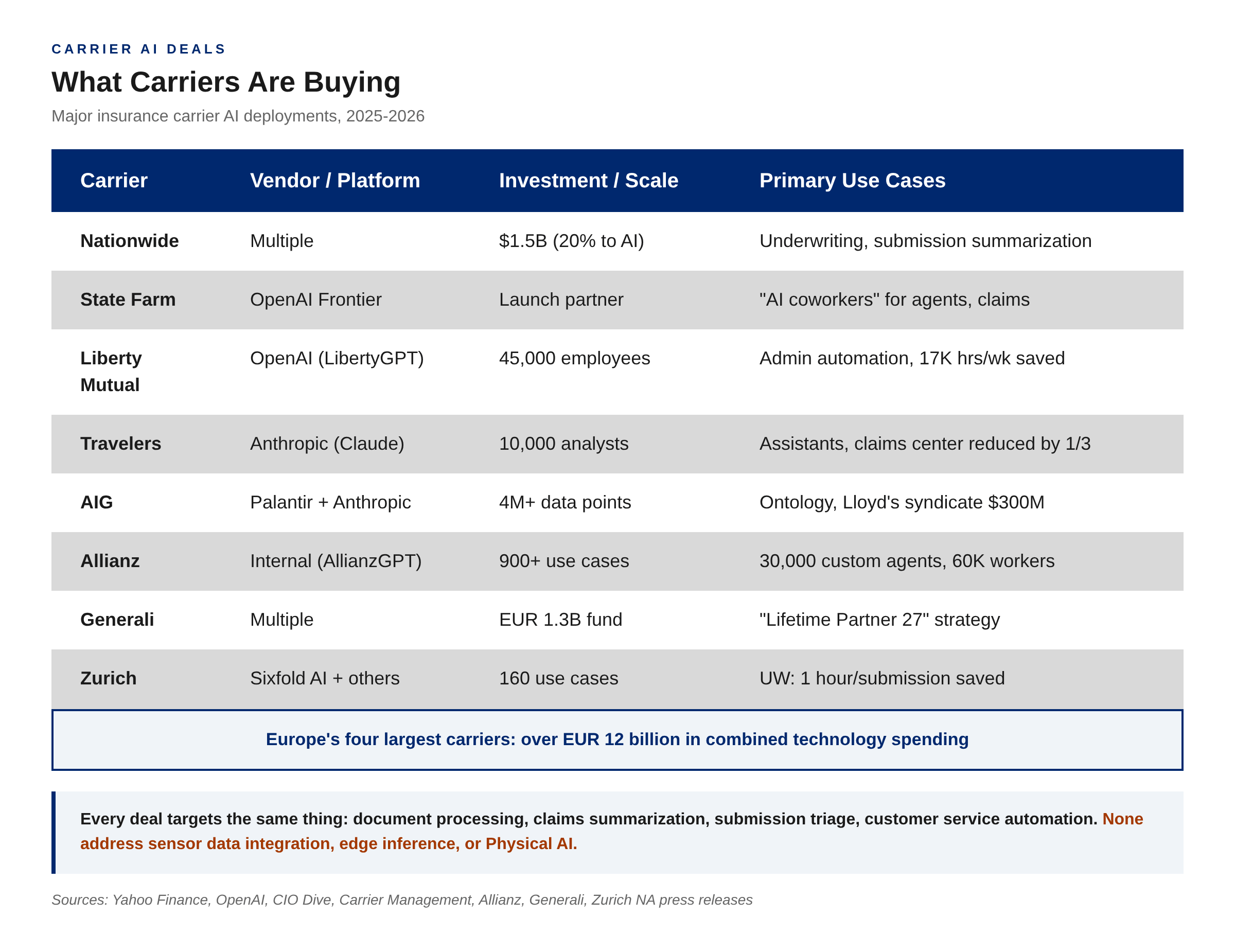
Every one of these deals describes the same thing: document processing, claims summarization, submission triage, customer service automation. The technology works. Zurich’s Sixfold AI integration saves approximately one hour per underwriting submission. Travelers achieves straight-through processing on more than 50% of eligible claims files. Liberty Mutual’s auto damage estimator is trained on 200 million data points across five million claims. These are real operational gains.
The gains are worth capturing. A carrier that saves 17,000 administrative hours per week or achieves straight-through processing on half its eligible claims is making a rational, defensible investment in expense-ratio reduction. Corporate officers are right to pursue these returns. But expense-ratio improvement through workflow automation is not a business model change. It is not new revenue. It is not a new product architecture. It is faster execution of an existing process through existing data. The distinction matters because the vendors, the consultants, and the PE-backed ventures are structured to sell optimization as transformation. The carrier gets a real operational gain. The vendor gets to claim an enterprise AI deployment. The PE sponsor gets a guaranteed return. Everyone profits. But the carrier’s competitive position relative to the sensor data opportunity scaling underneath the industry has not changed.
None of these deals address sensor data integration, edge inference, parametric product design, or the Physical AI data layer scaling underneath the industry. None move the carrier toward the new revenue sources that require new data. Every deal optimizes existing workflows through existing business models, faster.
As I documented in Optimized Satisficing earlier this year, carriers cycle through vendor partnerships while the organizational constraints remain unchanged. AIG’s public record illustrates the pattern across three technology eras in nine years: the Two Sigma venture (2016, divested), the Palantir partnership (2021, ongoing), the Anthropic relationship (2025, announced at Investor Day). The language was recycled nearly verbatim each time. This brief does not revisit that case. It examines who profits from the pattern and what it obscures.
The shift from FOMO to FOMU (Fear of Messing Up) is already visible. Early adopters found enterprise AI solutions had questionable data training practices, unpredictable results, and roadmap instability. BCG’s 2026 P&C Research Index found that only 38% of P&C insurers generate value at scale from AI within core workflows. AI spending as a share of carrier revenue is projected to triple in 2026, but measurable returns remain elusive. MIT’s Project NANDA reported that 95% of generative AI pilot programs failed to deliver measurable financial returns, though the research is early-stage and the sample reflects an adoption environment still in formation. Per S&P Global Market Intelligence, 42% of companies abandoned most generative AI initiatives in 2025, up from 17% the prior year. The NANDA findings are directionally consistent with what carriers report anecdotally, but should not be treated as a settled verdict on the technology’s potential.
Munich Re’s decision to shutter its $1.2 billion venture arm is a signal worth reading carefully. The 40-person team made approximately 100 investments over a decade. Munich Re shut it down despite recording EUR 2.1 billion in quarterly profit, bringing innovation under its asset management arm MEAG. When the most sophisticated corporate VC in insurance retreats from startup investing to concentrate innovation in core business, the signal is not that innovation failed. The signal is that the venture model failed.
The carriers that announced AI partnerships are not making bad technology decisions. The technology works. They are buying optimization of a business model that needs transformation, and the vendors selling to them are structured to profit from the optimization, not the transformation.
3. The Commodity Dynamic
The product these ventures deploy is commoditizing underneath them. But the commoditization is not producing the outcome most analysts expect. The model market is not consolidating toward a single winner. It is fragmenting, for structural reasons that the PE-backed consulting ventures cannot overcome.
The pricing collapse -- and the bifurcation underneath it. In early 2024, frontier language model inference cost roughly $60 per million tokens. By mid-2026, the commodity tier has crashed to $0.10 to $0.14 per million input tokens: DeepSeek V4 Flash at $0.14, GPT-4.1 Nano at $0.10, Gemini Flash-Lite at $0.10. The average output price decline since March 2023 is 94.5% using a price-index methodology benchmarked to GPT-4 at launch. Commodity tier output prices fell roughly 80% year over year, from approximately $0.50 to $0.70 per million tokens in mid-2025 to the $0.10 to $0.14 range by mid-2026. Enterprise token costs dropped from $18.40 to $6.07 in a single year, a 67% decline. Epoch AI documents a 50x annual decline rate in inference costs. For comparison, Moore’s Law delivered approximately a 2x improvement in transistor density every two years, or roughly 10x per decade. AI inference costs are declining at roughly 50x per year, a pace that ARK Invest and multiple analysts describe as outpacing Moore’s Law by 50 to 100 times. This is the fastest cost deflation curve in the history of computing.
But the pricing story has a second chapter that most analysis misses. While commodity prices crater, frontier pricing has held firm or increased with each new model release. GPT-5.5 runs at $5 input and $30 output per million tokens. GPT-5.5 Pro, the most expensive model on the market, costs $30 input and $180 output. Claude Opus 4.6 sits at $5 and $25. The spread between GPT-5.5 Pro at the frontier ceiling and GPT-4.1 Nano at the commodity floor is 450x on output tokens. Against the cheapest available model, DeepSeek V4 Flash at $0.28 per million output tokens, the spread widens to 643x. That is not a marginal pricing difference. It is a two-tier market.
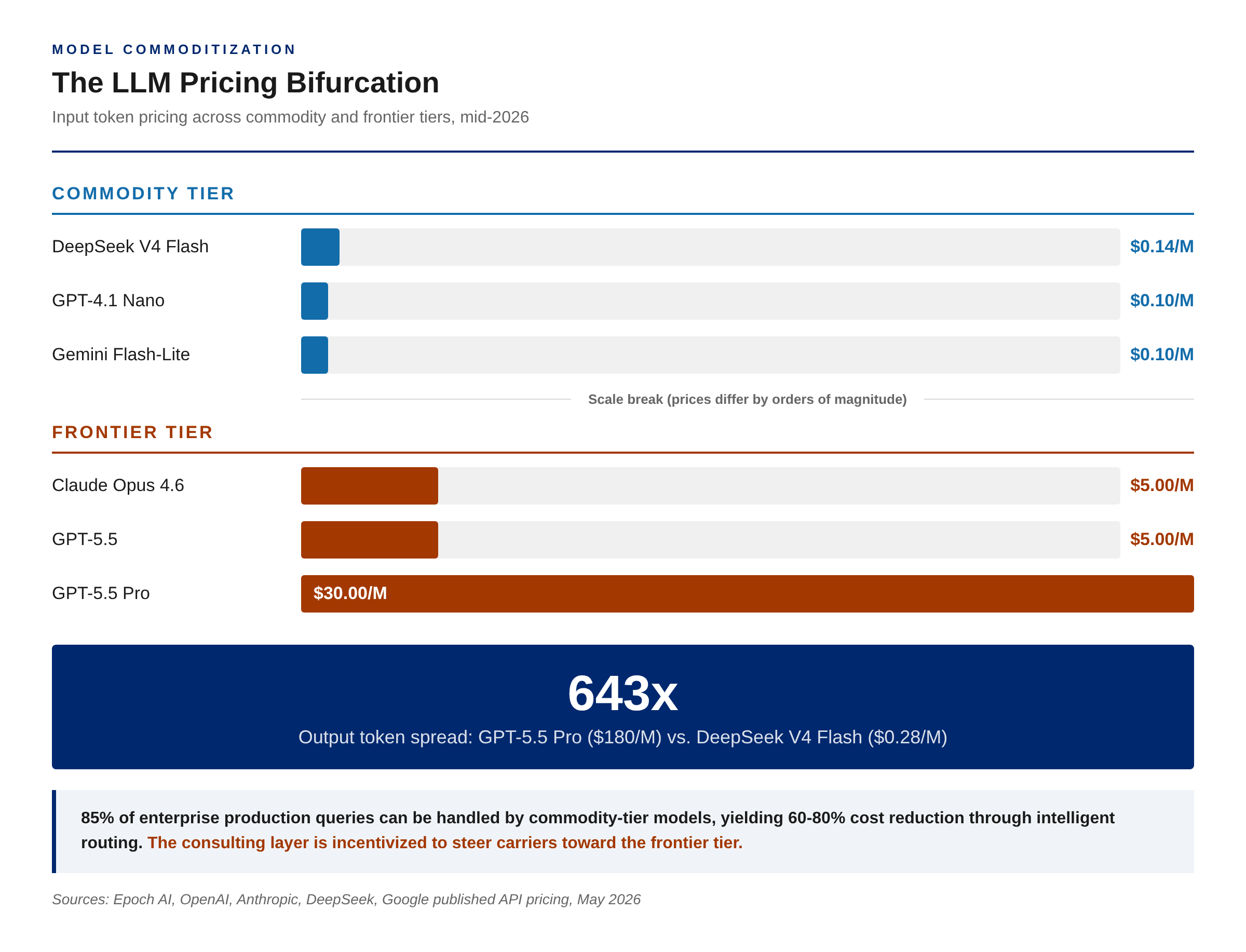
The commodity tier is genuinely good news for carriers. A procurement team that routes 85% of queries through $0.10 models and reserves frontier capacity for the 15% that requires it can capture enormous value from the technology at a fraction of the cost. Enterprise routing benchmarks aggregated across multi-model proxy tools and infrastructure platforms indicate that 85% of production queries can be handled by budget-tier models, yielding 60-80% cost reduction through intelligent routing. The issue is not the model pricing. The issue is the consulting layer between the carrier and the model. PE-backed consulting ventures need carriers on the expensive tier. Multi-year frontier-tier capacity contracts at $5 to $30 per million tokens justify the need for expensive deployment engineers who can “optimize” the premium product. The 85% of queries that could run on budget models at a fraction of the cost are not a talking point in the consulting pitch.
OpenAI launched “Frontier” in February 2026, an enterprise platform offering 1-3 year guaranteed capacity contracts with tiered volume discounts. The pricing is contact-sales only. Multi-year compute commitments convert AI spend into something resembling cloud infrastructure contracts, which is exactly the procurement model insurance CIOs are familiar with and the consulting intermediaries are incentivized to recommend.
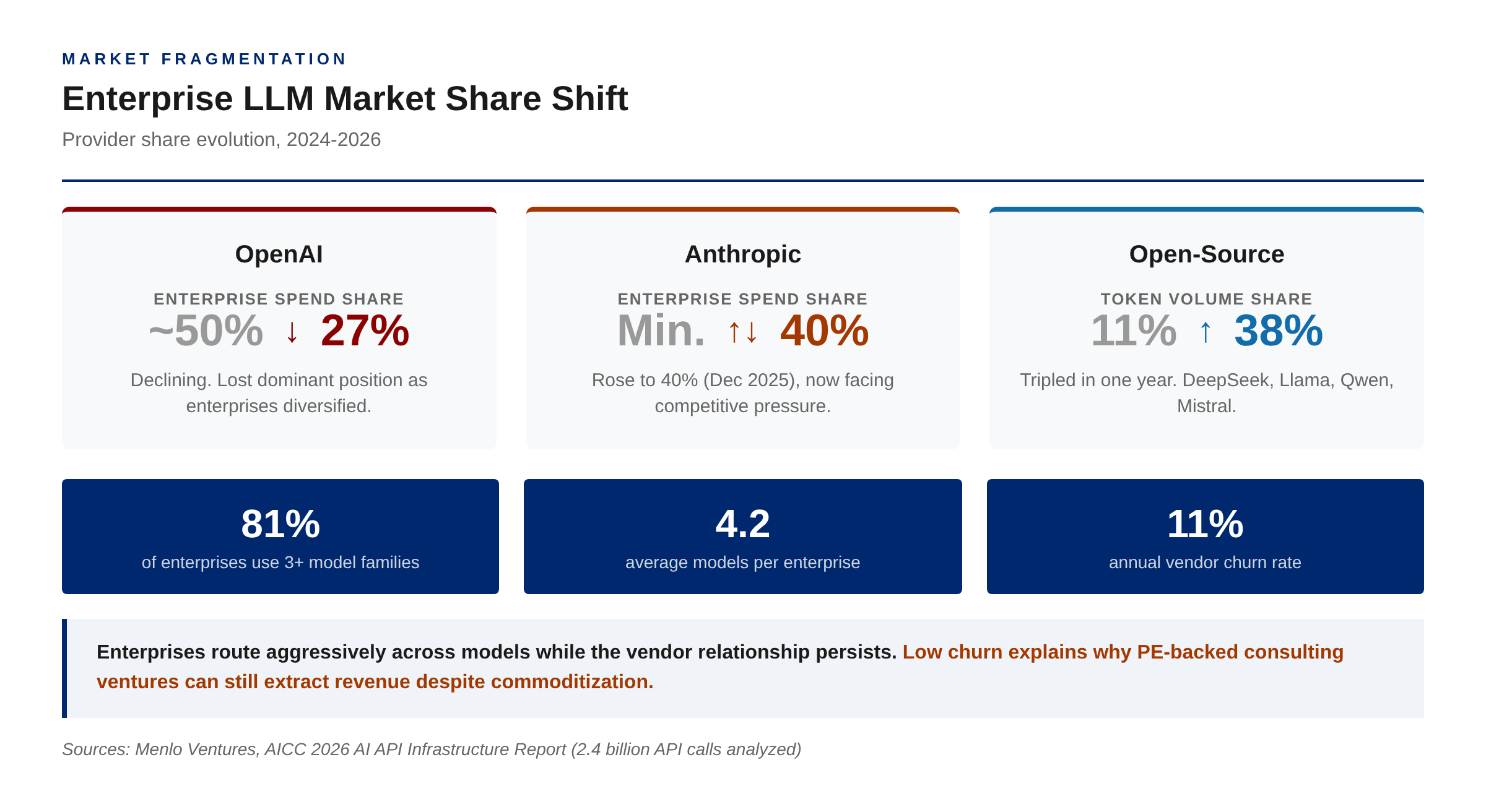
The switching reality. Enterprise model switching behavior requires careful parsing. Eighty-one percent of enterprises now use three or more model families. The average enterprise runs 4.2 AI models, up from 1.9 in 2023. Multi-model routing architectures cut costs 30% to 85% while maintaining 95% or higher quality. This looks like the model layer is a commodity. But actual annual vendor churn is only 11%, per Menlo Ventures survey data. Enterprises route API calls across multiple models aggressively but rarely switch the vendor relationship. The distinction matters: the 11% vendor churn rate explains why PE-backed consulting ventures can still extract revenue despite commodity pricing. The enterprise is locked into the consulting relationship even as it routes around the model. What changes primary model selection on any given day is latency, cost, or task fit. What changes the vendor relationship is a procurement cycle that moves at the speed of enterprise bureaucracy, not the speed of API routing.
Per Menlo Ventures enterprise tracking data, OpenAI’s enterprise spend share has fallen from approximately 50% to 27%. Anthropic’s share rose to 40% by December 2025, driven by Claude Sonnet 3.5’s coding performance, then began facing the same competitive pressure. The duopoly is collapsing in terms of model usage even as the vendor relationships persist. Per the AICC 2026 AI API Infrastructure Report, open-source and open-weight models captured 38% of enterprise token volume in Q1 2026, up from 11% in Q1 2025, based on anonymized data across more than 2.4 billion API calls.
Why the market fragments rather than consolidates. The database market provides the structural analogy. When distributed databases emerged, engineers believed a single database would serve all workloads. The CAP Theorem proved otherwise: no distributed system can simultaneously guarantee consistency, availability, and partition tolerance. The market fragmented along workload lines into relational, document, graph, time-series, columnar, and key-value stores. No single database won because the constraints were mathematically irreconcilable.
The LLM market faces the same structural logic. No single model simultaneously optimizes for speed, cost, accuracy, privacy, domain specialization, and latency. Different use cases optimize different constraints. Insurance underwriting prioritizes accuracy and regulatory compliance. Customer service prioritizes speed and cost. Coding prioritizes context window and instruction following. Edge deployment prioritizes size and latency. The market fragments not because the models are bad but because the workloads are heterogeneous.
The Herfindahl-Hirschman Index for the enterprise LLM market suggests a moderately concentrated oligopoly, not a winner-take-all structure. This is not the market structure that justifies a $10 billion consulting venture built around a single model provider.
The specialist unbundling. Domain specialists are capturing revenue that once flowed to generalist model providers. The pattern is consistent across categories, and the Corpus Search evidence maps it in detail.
In customer service, Intercom’s Fin Apex 1.0 achieves a 73.1% resolution rate, outperforming GPT-5.4 and Claude Opus 4.5. Intercom built a proprietary post-trained model and charges $0.99 per resolved conversation. Anthropic and OpenAI receive zero revenue. Decagon routes 80% of model traffic through its own trained models. Sierra AI runs 15 or more models simultaneously across 40% of Fortune 50 companies and plans to replace third-party models entirely with custom-trained alternatives.
In document processing, Reducto’s vision-first parsing scores approximately 0.90 on RD-TableBench versus 0.81 for Google Document AI, using proprietary models. Rossum’s Aurora processes documents for 450 organizations including Bosch and Siemens on a proprietary transactional LLM. Generalist LLMs treat document pages as flat, serialized text, destroying the spatial and tabular relationships that document processing requires. The specialists solved this with vision-first pipelines that bypass LLM APIs entirely.
In software development, the unbundling is happening in real time. Windsurf (Codeium) reports processing context at 950 tokens per second through its proprietary SWE-1.5 model served on Cerebras hardware, approximately thirteen times faster than Claude Sonnet 4.5. Cursor, once a distribution channel sending API revenue to Anthropic, shifted its backend to Kimi K2.5 from Moonshot AI, which scores 76.8% on SWE-Bench Verified versus Claude Sonnet 4.6 at approximately 72%. Today’s distribution channels are tomorrow’s revenue competitors.
In insurance specifically, the specialist ecosystem runs deeper than most coverage acknowledges. Shift Technology is trusted by four of the top five US P&C insurers, operating natively inside Guidewire ClaimCenter with a hybrid engine combining statistical data science with generative AI agents. Sixfold AI runs quantized open-weights models within isolated single-tenant environments on carrier Azure budgets. Indico Data operates 80 proprietary models across 120 product lines. Tractable’s computer vision for damage assessment is not LLM-based at all. Earnix deploys predictive and agentic AI directly into the underwriting, pricing, and product personalization cycle, allowing actuaries to adjust and execute pricing rules in real time. For actuarial work, ActuBench found that a Gemma 4 model on consumer hardware sits on the cost-performance Pareto front, within one item of the leaderboard top.
In compliance and regulatory technology, the unbundling is already complete. The RegTech AI market, valued at $14.9 billion and projected to reach $107 billion by 2035, is 95% independent of generalist LLMs because it predates them entirely. Financial institutions are deploying “dual-model architectures” where a primary generative model produces outputs and secondary specialized models audit those outputs in real time for bias, numerical errors, and regulatory violations, all hosted within isolated virtual private clouds where no client data touches external servers.
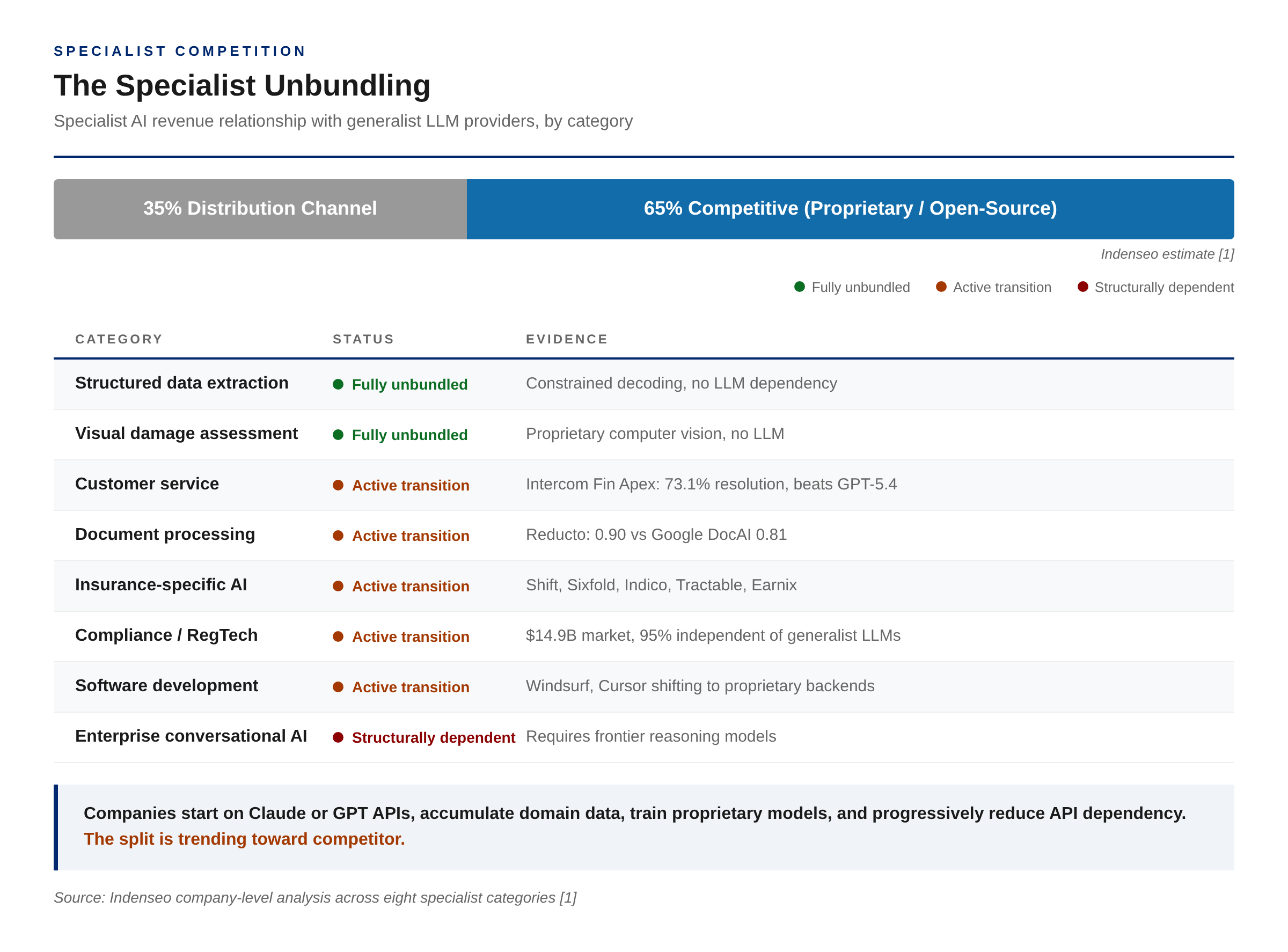
The trajectory follows what I call the “specialist start, proprietary end” pattern. Companies start on Claude or GPT APIs, accumulate domain-specific data, train proprietary models that outperform generalists on their specific tasks, and progressively reduce API dependency. Based on Indenseo’s company-level analysis across eight specialist categories, approximately 35% of specialist AI revenue still functions as a distribution channel for generalist LLM providers while an estimated 65% has become competitive, using proprietary or open-source models. The split is trending toward competitor. Two categories are already fully unbundled: structured data extraction (where constrained decoding libraries mathematically guarantee output compliance, eliminating the need for generalist API calls) and visual damage assessment (where proprietary computer vision has no LLM dependency). Four categories are in active transition. Only enterprise conversational AI remains structurally dependent on frontier reasoning models.
The financial exposure. OpenAI’s revenue is growing: CFO Sarah Friar confirmed the company surpassed $20 billion in annualized revenue in 2025, tripling from approximately $6 billion in 2024, with $29.4 billion projected for 2026. But the company’s cost structure remains inverted. Compute and technical talent consume approximately 75% of total revenue. Gross margin sits at approximately 33% against a SaaS industry benchmark of 75% to 85%. HSBC estimates OpenAI requires $207 billion or more in additional capital through 2030. That figure exceeds the GDP of New Zealand and approaches the GDP of Portugal: a single company’s capital needs rival the annual economic output of a developed nation. The company has $1.4 trillion in long-term compute commitments, a figure approaching the GDP of Australia ($1.7 trillion) or Spain ($1.6 trillion): a single company has committed to spending on computing infrastructure what entire developed nations produce in a year. OpenAI revised this target down to approximately $600 billion by 2030 in February 2026, meaning even the company’s own infrastructure projections are contracting. Twelve or more senior executives departed in 2025, with a triple exit in April 2026. Revenue is growing. The economics underneath the revenue are not.
Anthropic’s trajectory is different in degree but not in kind. The company reached a $30 billion annualized run rate by April 2026, with 80x revenue growth in Q1 2026. Claude Code alone generates $2.5 billion in annualized revenue. Anthropic holds 40% of enterprise LLM spend, ahead of OpenAI at 27%. Its burn rate is projected to drop to approximately 9% of revenue by 2027, compared to OpenAI’s 57%. These are real strengths. But 75% of that revenue flows through platforms controlled by Amazon, Google, and third-party tools. Amazon is building Nova models that directly compete with Claude on the same Bedrock platform where Anthropic generates most of its revenue. When your largest distribution partner is also your most motivated competitor, the revenue looks less durable than the growth rate implies.
Both companies launched PE-backed consulting ventures within 36 hours. That timing is not coincidental. It is a coordinated market signal that neither company’s model revenue alone can sustain the growth trajectory their valuations require.
The production reality. Vera Engineering documented removing all OpenAI from its production platform, citing poor scaling, high latency, lack of version control, and neglect of mid-size enterprises. A former OpenAI engineer described the internal codebase after growing from 1,000 to 3,000 employees in a single year. Independent testing documented measurable API degradation in Anthropic’s long-context coherence. RAG systems, the backbone of most enterprise AI deployments, fail silently in production through retrieval drift, embedding decay, and the “lost in the middle” problem where models lose track of information in long contexts. Indian venture capital data provides a retention signal: AI copilots claiming 30% time savings showed 15% to 25% ninety-day retention. Meanwhile, “boring” compliance automation with 80% retention raised capital in 45 days. The tool that sounds transformative does not stick. The tool that automates a specific, measurable workflow does.
The clearest framing came from conversations with sensor OEM representatives who view models as “a feature, not a product.” The observation lands differently when you consider that telematics companies have been running machine learning models for more than twenty years. Nobody calls Geotab or Samsara an ML company. Samsara, with $1.9 billion in annual recurring revenue and 55 million connected sensors, describes itself as a “Connected Operations Platform.” Geotab, with more than five million connected vehicles, calls itself a “connected transportation solutions” provider. Karooooo, with 2.6 million subscribers across Africa, uses an “intelligent SaaS platform.” The ML is embedded. It is invisible. It is infrastructure. That is the trajectory. The PE-backed ventures are building a consulting business around a product category following the same arc.
4. Three Paths
Three distinct purchasing paths exist for carriers buying AI capabilities. They are not equivalent, and the differences matter more than most carrier procurement processes acknowledge.
Path 1 is the direct model company deal. The carrier signs with Anthropic or OpenAI, gets document processing and claims summarization, and receives FDEs at $200,000 to $300,000 per year. The carrier pays for a commodity product plus expensive humans, with PE taking a guaranteed return. The carrier gets optimization of existing workflows. It does not get access to new data sources, new product architectures, or the sensor layer where insurance-relevant data is being generated. Path 1 is also a distribution subsidy: the carrier’s contract helps the model company demonstrate enterprise revenue to justify its valuation, while the PE sponsors extract their guaranteed 17.5% regardless of whether the carrier sees measurable operational improvement. And the consulting intermediary steers the carrier toward multi-year frontier-tier capacity contracts at $5 to $30 per million tokens when 85% of production workloads could run on models priced at $0.10 to $0.50.
Path 2 is the platform deal. Microsoft Azure AI Foundry now offers access to more than 11,000 models, including Claude, DeepSeek, Mistral, Llama, and Microsoft’s own MAI family launched in April 2026. The value proposition is model optionality with enterprise security. Interviews with hyperscaler representatives confirm the strategy: the platform is a foundry, not an exclusive relationship. The carrier can switch models as the market evolves without renegotiating vendor contracts. Given that 81% of enterprises already use three or more model families and multi-model routing cuts costs 30% to 85% while maintaining quality, the foundry approach aligns with how enterprises actually consume AI. Path 2 is rational cloud infrastructure. But it is still a cloud play. It does not move the carrier toward sensor data.
Path 3 is edge and Physical AI. On-device inference. Sensor data processed at the point of collection. No cloud dependency for time-critical decisions. The parametric insurance opportunity. The predictive maintenance opportunity. The mechanical health usage-based insurance opportunity. The ESG monitoring opportunity. Path 3 is where the new products are.
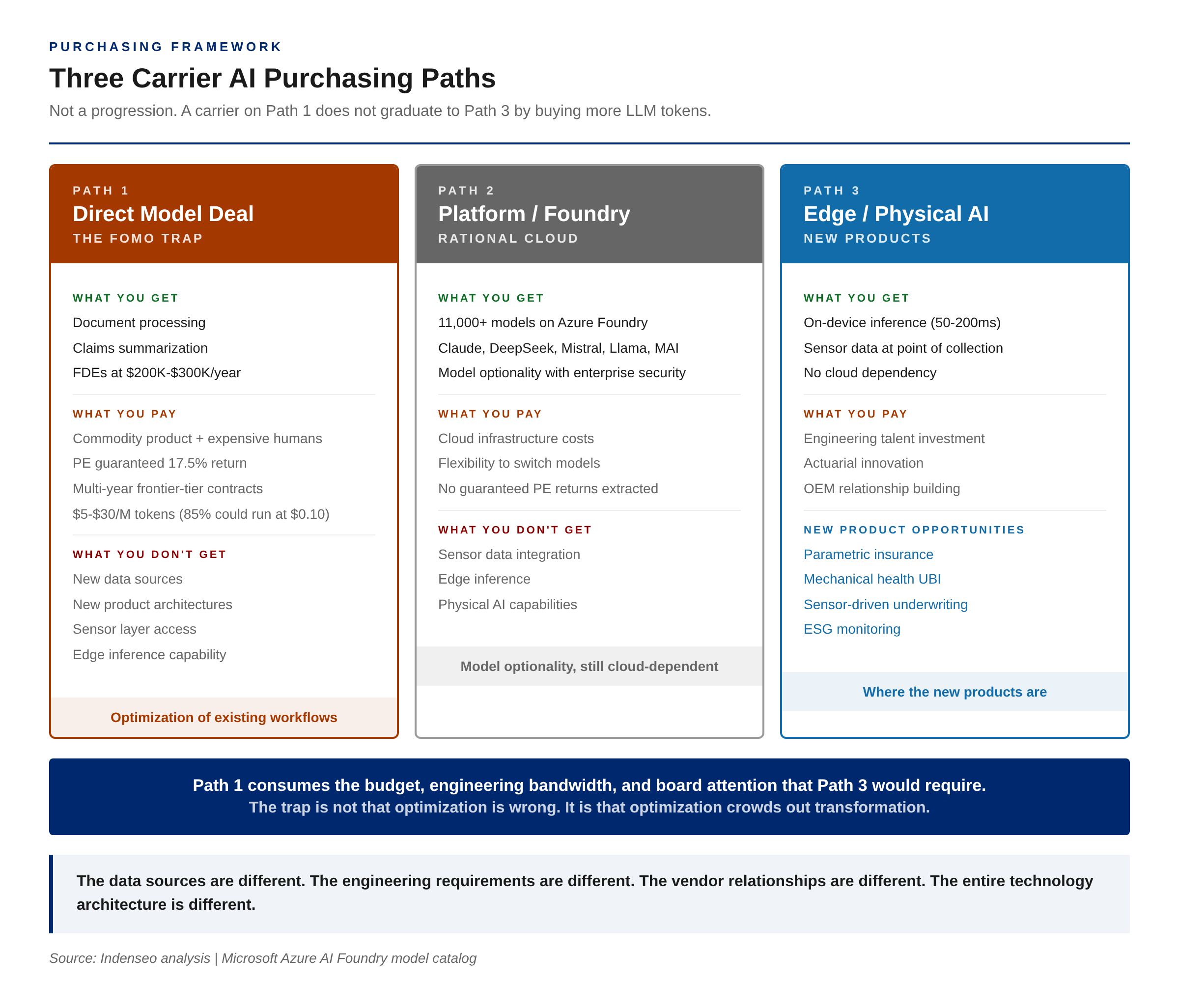
The structural point: these paths are not a progression. A carrier on Path 1 does not graduate to Path 3 by buying more LLM tokens. The data sources are different. The engineering requirements are different. The vendor relationships are different. The entire technology architecture is different. Path 1 does not physically prevent a carrier from pursuing Path 3. A multi-billion-dollar insurer can, in theory, parallel-track both. But in practice, Path 1 consumes the scarce resources that Path 3 requires: not just budget, but engineering leadership bandwidth, board-level attention, and the organizational willingness to absorb a second major technology initiative while the first is still being justified. The carriers that have signed Path 1 deals are not unable to pursue Physical AI. They are unlikely to, because every quarterly review cycle spent demonstrating ROI on the LLM engagement is a cycle not spent building sensor data capabilities that have no existing vendor relationship to anchor them.
The local inference trajectory reinforces the point. At Google I/O 2026, Google announced Gemini Intelligence embedded in Android 17 for multi-app task automation on flagship devices, while also expanding web-based Gemini automation features to phones with 4GB or more of RAM. Apple’s WWDC 2025 revealed a rebuilt Siri powered by on-device models with a 3-billion-parameter foundation model available to all developers through a Swift API at zero cost. Google distributes AI through 3 billion Android devices and Chrome’s 65% browser share. Apple distributes through 2.5 billion active devices. Both companies give inference away because they make money from advertising, hardware, and ecosystem, not from inference. The carrier’s Path 1 vendor sells inference. The platforms that control the surfaces enterprises interact with are making inference free. That is a structural mismatch the consulting venture cannot resolve.
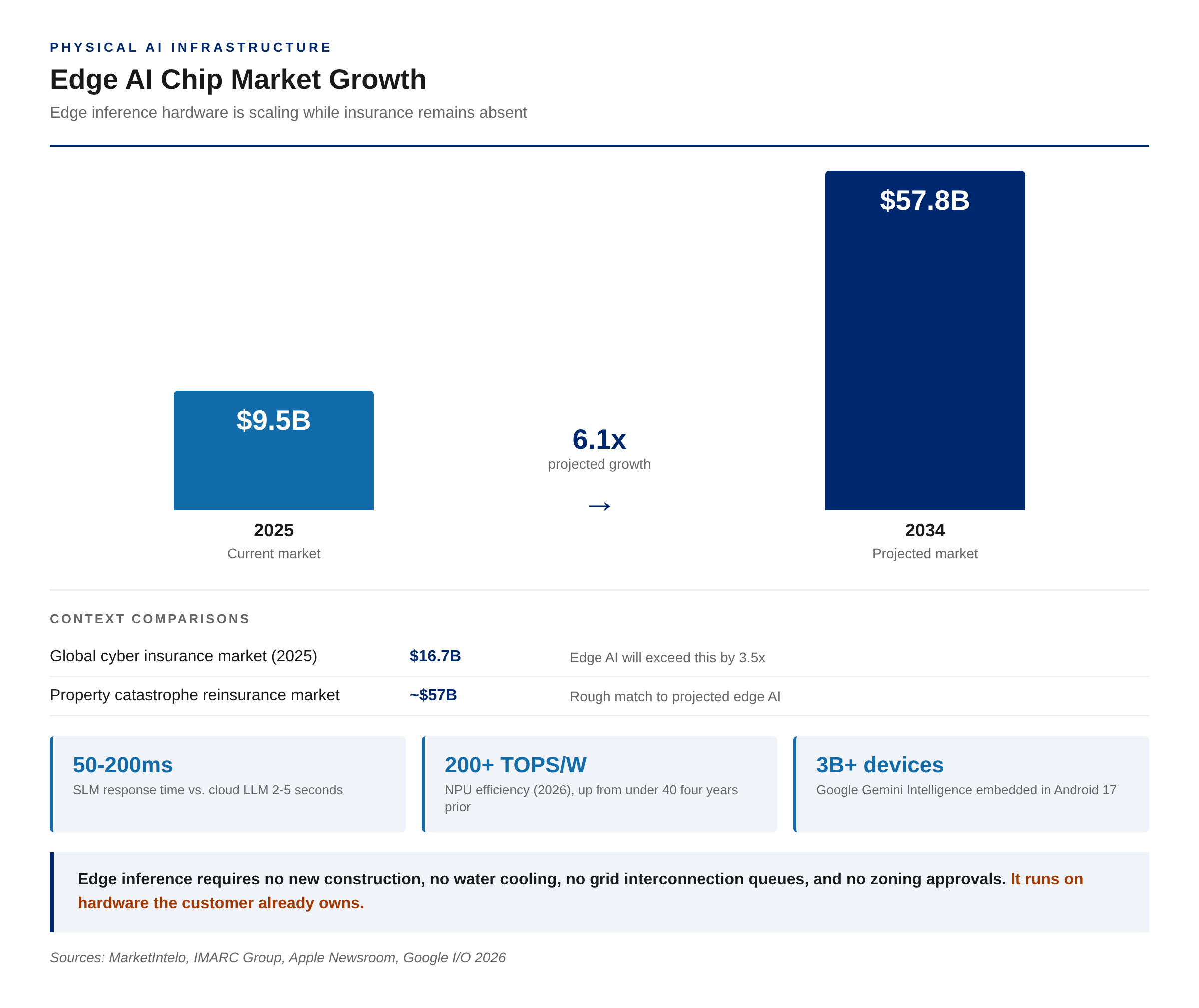
Cloud-dependent AI also faces a growing infrastructure wall that local inference sidesteps entirely. Data compiled by the Lawrence Berkeley National Laboratory (LBNL) shows US data centers consumed roughly 176 terawatt-hours of electricity in 2023, accounting for 4.4% of total US consumption, and are projected to reach 325 to 580 terawatt-hours by 2028. Data centers now account for half of all new US electricity demand growth. Water consumption hit 17.4 billion gallons in 2023, projected to reach 38 to 73 billion gallons by 2028. In regulatory filings, NV Energy notified regulators it is redirecting 75% of the electricity supply serving 49,000 Lake Tahoe-area residents to data centers in Northern Nevada. Public records requests in Fayette County, Georgia revealed that a QTS data center facility secretly consumed 29 million gallons of unmetered water over 15 months before residents detected it through low water pressure. The North American Electric Reliability Corporation (NERC) issued a Level 3 alert, its highest operational severity, over data center load disruptions threatening grid reliability. PJM Interconnection, which serves 65 million people across 13 states, projects a six-gigawatt capacity shortfall by 2027: roughly the output of six large nuclear reactors, or enough electricity to power approximately 4.8 million homes. National project trackers confirm that more than $64 billion in data center projects have been blocked or delayed by community opposition in the past two years. At least 142 activist groups across 24 states are organizing against construction, and 14 states have enacted temporary construction pauses. These constraints do not mean a carrier’s API queries will be physically throttled tomorrow. They mean the operating cost trajectory for cloud-dependent AI infrastructure is rising while edge inference costs continue to fall. Edge inference requires no new construction, no water cooling, no grid interconnection queues, and no zoning approvals. It runs on hardware the customer already owns.
The hidden cost curve of integration middleware reinforces the lock-in. Enterprise middleware follows what one analysis calls a “vicious cost cycle”: affordable at launch, cost-unpredictable at scale. The total cost of ownership gap between projected and actual spend grew to nearly 40% at one financial services firm. Organizations three to five years into a middleware relationship have hundreds of integrations, trained teams, and interconnected APIs. Switching feels impossible. That is the structural dependency the PE-backed consulting ventures are designed to create.
A Sri Lankan architect who transformed one of Asia’s oldest insurers offers the counter-model. He built integration layers over legacy systems rather than pursuing the rip-and-replace approach Western consultancies recommend. His track record: 40% to 50% premium growth versus competitors stuck in multi-year platform migrations. His advice to carriers in emerging markets: stop listening to big consultancies. His rule: AI projects that do not connect directly to revenue metrics do not survive budget cycles.
5. The Physical AI Blindspot
The insurance industry has no seat at the Physical AI table. This is not an opinion. It is a quantifiable absence.
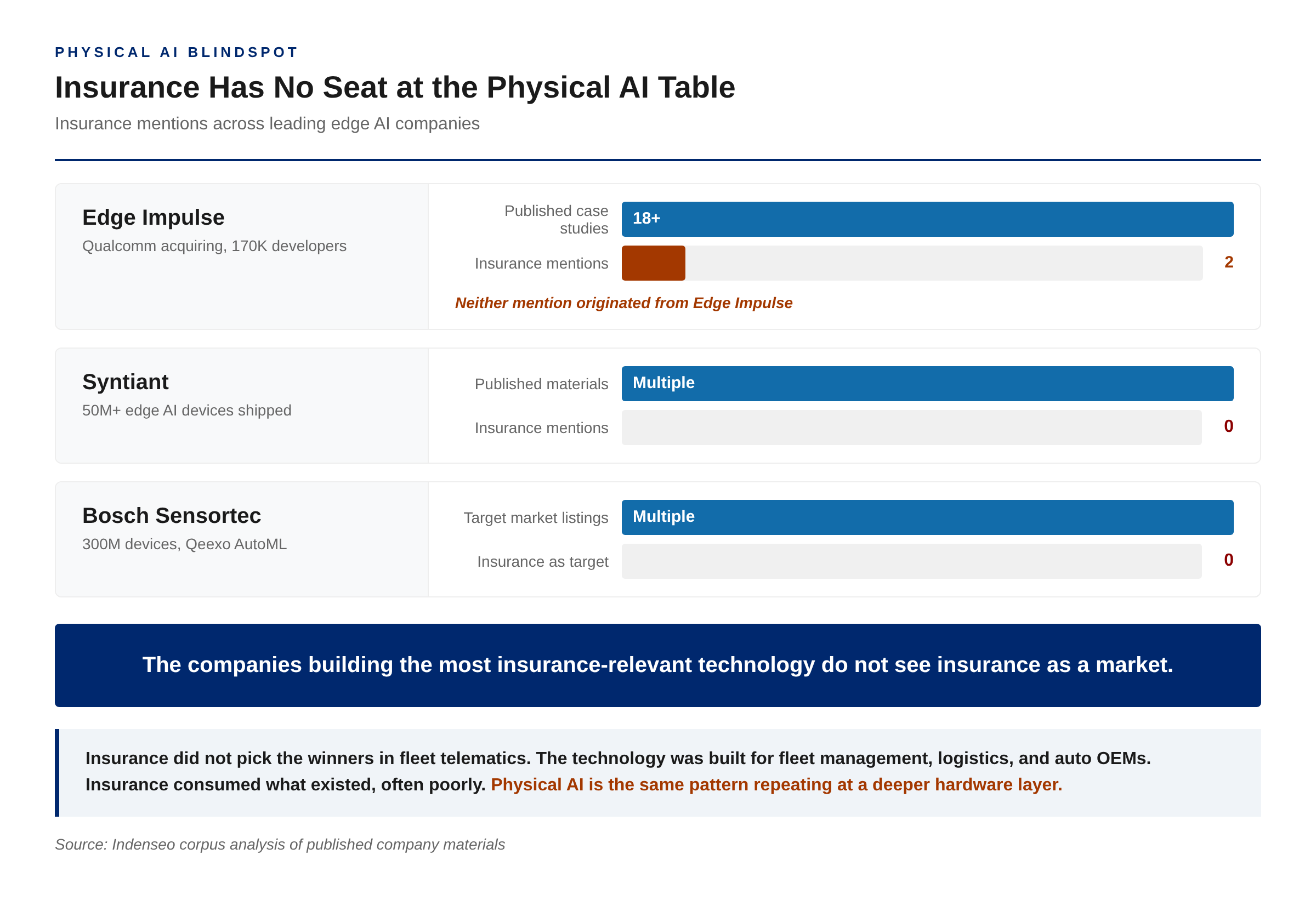
Edge Impulse, the company Qualcomm is acquiring along with its 170,000-developer community, has published more than 18 case studies. Only two mention insurance, and neither originated from Edge Impulse itself. They were identified through our analysis, not through the company’s own market targeting. Syntiant, which has shipped more than 50 million edge AI devices, has zero insurance mentions in its published materials. Bosch Sensortec, with 300 million devices running Qeexo AutoML, does not list insurance as a target market. The companies building the most insurance-relevant technology do not see insurance as a market.
The edge AI chip market is scaling from $9.5 billion in 2025 to a projected $57.8 billion by 2034. For scale, $57.8 billion would exceed the current global cyber insurance market ($16.7 billion in 2025) by more than three times, or roughly match the global property catastrophe reinsurance market. The edge AI chip market is on track to become larger than many insurance verticals that carriers consider core business. Small language models deliver local inference in 50 to 200 milliseconds versus 2 to 5 seconds for cloud-hosted LLMs. Neural processing unit efficiency exceeds 200 TOPS per watt in 2026, up from under 40 four years prior. Half-billion-parameter models now run inference on a Raspberry Pi in two to four seconds. Apple’s depth-split architecture applies a 5:3 layer-sharing ratio within its local model blocks to achieve a 37.5% reduction in KV cache memory usage, while separate flash-memory mapping techniques enable devices to run models that exceed their raw RAM capacity. Apple’s Private Cloud Compute, built on custom silicon with Secure Boot and Secure Enclave, contains no privileged interfaces, no remote shells, and no debug tools, making it architecturally impossible for any operator, including Apple, to access user data in the cloud compute layer.
The telematics precedent is instructive. Insurance did not pick the winners in fleet telematics. The technology was built for fleet management, logistics, and auto OEMs. Insurance consumed what existed, often poorly. As I documented in Why Insurance Telematics Integrations Fail for Carrier Management, the same five failure modes appear regardless of carrier size, vendor selection, or technical architecture: the legacy architecture trap, data quality mismatch, workflow adoption failure, timeline mismatch, and departmental silos. Physical AI is the same pattern repeating at a deeper hardware layer.
What makes the current moment different is what is happening in markets that most Western carriers are not watching.
In Kenya, the Kilimo Salama program (Syngenta Foundation, UAP Insurance, Safaricom) operates parametric crop insurance on a sensor-to-payment stack: automated solar-powered weather stations broadcast rainfall data over Safaricom’s 3G network. When rainfall drops below a regional threshold, payouts trigger directly via M-Pesa. No claims forms. No adjuster. No chatbot. No LLM. The program started with 200 farmers in 2009 and has scaled to more than 1.7 million smallholder farmers across five countries, with $181 million in total sum insured.
ACRE Africa’s picture-based insurance combines satellite imagery with smartphone photographs of crops at growth stages, registration via USSD, and premiums and payouts via M-Pesa. In Rwanda, Sawa Telematics processes more than 10 million data points per day across over 3,000 connected vehicles at approximately $9 per vehicle per month. In South Africa, MTN and Huawei deployed OBD telematics devices feeding data directly to insurers for usage-based pricing. In India, Reliance launched JioMotive, an OBD-based telematics system retailing at approximately $79, targeting vehicle segments that factory-installed telematics does not reach. ICICI Lombard launched pay-as-you-use and pay-how-you-use motor insurance using telematics built independently of Western consulting firms.
The distribution infrastructure is already in place, with USSD codes effectively serving as the operating system for African insurance delivery. This model thrives through both dedicated insurance channels, like Sanlam Nigeria (1056#) and Heirs Insurance (1100#), and embedded micro-insurance products integrated directly into everyday mobile network menus, such as Safaricom Kenya (544#), Airtel Kenya (334#), and Telkom Kenya (444#). Monthly premiums start at $0.24. Insurance is bundled with mobile data plans. The Sanlam/MTN aYo alliance distributes micro-life and hospital-cash insurance across 19 African countries, with 6.3 million active policies and a target of 30 million policyholders leveraging MTN’s 100 million active mobile wallets.
These implementations share a structural feature: the sensor-to-payment stack (weather stations, satellite, telematics, IoT sensors to USSD/SMS to M-Pesa and mobile money) has no natural entry point for the LLM consulting layer. The $200,000-per-year Forward Deployed Engineer has no role in a system where a solar-powered weather station triggers an M-Pesa payment.
A necessary caveat: Western commercial insurance operates under fundamentally different regulatory frameworks, risk pool structures, and capital requirements than Kenyan parametric crop insurance or Rwandan fleet telematics. The emerging markets evidence is included as architectural proof-of-concept for sensor-to-payment loops, not as a direct operational blueprint for a US commercial carrier. What it demonstrates is a principle: insurance products can be built on sensor-to-payment stacks without an LLM consulting layer in the value chain. The principle scales even where the specific implementation does not. The question for Western carriers is not whether to replicate M-Pesa-based parametric payouts, but whether the billions flowing into LLM optimization are building any capability that connects to the sensor data architectures where the next generation of insurance products will be designed.
Per Britam’s published corporate reporting, Britam Kenya built its AI Motor Assessment Service internally at BetaLab: image authenticity validation, damage severity detection, real-time repair cost estimation, settlement via M-Pesa, claims resolved within two hours. Not built by a $10 billion PE-backed consultancy. Built by a Kenyan insurer’s internal innovation lab. The Association of Kenya Insurers partnered with Microsoft Azure (not a consulting venture) for industry digitization, reporting 30% management cost reduction and 40% claims expense reduction per a published Microsoft partnership case study. Cloud platform play. Not consulting engagement.
The LoRaWAN soil moisture sensor market, valued at $1.8 billion in 2025, is projected to reach $4.9 billion by 2034. Agri-insurance firms are incorporating verified soil moisture monitoring into crop insurance underwriting. Smart contract parametric insurance from ACRE Africa and Etherisc delivered blockchain-based weather index coverage to more than 12,900 Kenyan smallholder farmers at an estimated 30% to 40% cost reduction versus traditional products.
The carriers spending billions on Path 1 AI deals are buying optimization of existing Western insurance workflows. The carriers they are not watching are building insurance products on sensor-to-payment architectures that those AI deals cannot serve.
6. The PE Playbook
Private equity firms have a business model. They standardize back-end operational functions across portfolio companies, drive efficiency through consistency, and extract returns through a proven playbook. It is a very successful model. It has generated extraordinary returns for decades. It is also a model designed for PE economics.
The logic extends to technology vendor selection. Tech startups tend to favor Google Workspace. PE firms often standardize portfolio companies on Microsoft Office, in part because it simplifies back-office integration when a portfolio company is acquired by a larger enterprise. The choice is rational for PE economics: consistency across a portfolio of 200 companies reduces operational friction at every stage from acquisition through exit. It would not necessarily be rational for a company making the decision purely on its own operational merits, where the best tool for its specific workflows might be different. The same logic applies to standardizing portfolio companies on a specific LLM vendor. When PE firms want exposure to novel, non-standard technology, they invest through venture arms built for that purpose. DeployCo is not a venture arm. It is the PE operational playbook applied to AI: standardize every portfolio company on a specific model vendor, whether or not that vendor relationship is the best solution for any individual company’s needs. Carriers should not mistake that playbook for a technology strategy.
The 17.5% guaranteed annual return to DeployCo’s PE sponsors over five years is the PE model working exactly as designed. It is a return structure, not a technology outcome metric. A technology investment generates returns when the technology produces value for the customer. A guaranteed-return structure generates returns when the customer pays. When the customer base is captive (2,000+ portfolio companies controlled by the PE sponsors themselves), the risk of non-payment approaches zero. Vista Equity takes the standardization logic further. As reported by the Financial Times in November 2025, Vista formally told its LPs it would score every portfolio company on AI adoption velocity and tie those scores to capital allocation decisions across its 90-plus software companies. This is operational standardization at scale, consistent with the PE playbook, applied to AI vendor selection.
The revenue mechanics are straightforward. FDE job postings confirm base compensation of $150,000 to $250,000 plus equity, with total compensation in the $200,000 to $300,000 range. The billing rate to the enterprise client is a multiple of that. Consulting firms that took equity positions in DeployCo bill senior consultants at $250 to $500 or more per hour for AI-specific work. The model itself is approaching commodity pricing. The humans required to make the model work are not. And the pricing bifurcation in the model market serves the consulting economics: steering clients toward frontier-tier contracts at $5 to $30 per million tokens rather than commodity alternatives at $0.10 to $0.50 justifies the need for expensive deployment engineers who can “optimize” the premium product. The 85% of queries that could run on budget models at a fraction of the cost are not a talking point in the consulting pitch.
The labor economics at the foundation of this system are worth examining. A TIME investigation documented that OpenAI paid its data labeling contractor Sama approximately $12.50 per hour. Sama paid the workers who built the safety systems underlying ChatGPT $1.32 to $2.00 per hour, an intermediary capture rate of 84% to 89%. Andela, a PE-backed engineering talent marketplace valued at $1.5 billion, sources software engineers from African markets at a fraction of the cost of US-based FDEs. The margin structure illuminates the incentive. When the model is a commodity and the consulting is the revenue, the incentive is to maintain complexity, not resolve it.
The FDE model creates structural dependency: the enterprise needs the FDE because it cannot do the work itself. The CIO functions as a purchasing agent, not an engineering leader, selecting vendors rather than building capability. The FDE engagement stretches because knowledge capture is irreducible, and the enterprise lacks the talent to assess whether the engagement should end. The FDE leaves; the enterprise needs another one. FDE demand has surged 800% since January 2025. Rippling credits FDEs with 90% customer retention at $500 million in ARR. These numbers demonstrate that the model works as a business. They do not demonstrate that it works as a technology outcome for the buyer.
The PE playbook is rational on its own terms. The standardized AI engagement gives each portfolio company an “AI transformation” narrative that can support exit multiples. The 17.5% guaranteed return on DeployCo capital is a protected income stream, structurally isolated from any individual portfolio company’s operational performance. The PE firm collects the consulting return with certainty while the narrative value of “AI-enabled operations” supports the exit thesis. This is sound PE economics. The question is whether a carrier, which is not a PE portfolio company and does not exit on PE timelines, should adopt a technology strategy designed for portfolio-wide standardization rather than for its own specific operational and competitive needs.
The distribution dynamics make the economics more fragile than they appear. The PE ventures create distribution by routing demand through captive portfolio companies and consulting relationships. But this is manufactured distribution, not structural distribution. Google, Microsoft, Apple, and Amazon distribute AI through billions of devices, operating systems, browsers, and cloud platforms. They give inference away because they monetize the ecosystem. DeployCo distributes AI through 2,000 portfolio companies. The scale mismatch is not close. And the 11% annual vendor churn rate that makes PE ventures viable today depends on enterprise procurement inertia, not product superiority. As multi-model routing becomes standard and the specialist unbundling continues, the consulting relationship becomes the only durable revenue source. The model revenue is already commodity. The consulting fee is next.
As model pricing collapses and open-source alternatives close the performance gap, deployment yield compression accelerates: each dollar of consulting spend produces less measurable enterprise value than the last, but the engagement structure is designed to persist regardless.
TPG’s capital allocation tells a more complete story than any press release. TPG led the $10 billion DeployCo investment. TPG’s Rise Funds also led a $350 million investment in Cambridge Mobile Telematics, the smartphone-based telematics company, with co-investors Allianz X and State Farm. TPG is simultaneously the largest investor in the LLM consulting venture and a leading investor in the Physical AI data layer. The distinction is revealing. When TPG wants standardized AI deployment across portfolio companies, it uses DeployCo. When it wants exposure to novel technology that does not fit the standardization playbook, it uses Rise. PE firms are disciplined about which instrument serves which purpose. Carriers buying into these ventures would benefit from applying the same discipline to their own technology decisions.
NVIDIA’s counter-bet deserves attention. Jensen Huang open-sourced NemoClaw, a security framework for AI coding agents that adds safety controls and governance guardrails to autonomous AI development workflows. The bet is explicit: developer competence, secured by open tooling, scales better than consulting armies. If enterprises can deploy and govern AI agents without $200,000-per-year humans, the PE-backed consulting venture loses its revenue engine. The model commoditizes. The consulting commoditizes. What remains is the data, the sensor infrastructure, and the engineering talent to connect them.
7. The Execution Question
Recognizing the asset class mismatch is necessary but not sufficient. The execution challenges facing any carrier that wants to move from Path 1 to Path 3 are real, and pretending otherwise would be dishonest.
The purchasing-agent CIO cannot evaluate whether the FDE deployment worked because the organization lacks the engineering talent to assess outcomes. The AI-insurance talent intersection is, by multiple accounts, “exceptionally narrow.” Carriers posting Silicon Valley skill stacks at insurance compensation levels are not solving this. The 400,000 insurance professionals projected to exit the industry are taking institutional judgment with them, and the AI systems being deployed without capturing that expert knowledge will produce average-performing outputs at best.
The brain drain is cognitive, not mechanical. Experienced underwriters report identical language across carriers: “I’m not burned out from underwriting. I’m burned out from everything around it.” Senior underwriters spend meaningful time reviewing out-of-appetite submissions, re-entering data across systems, and writing extended documentation for modest pricing decisions. They start trading clarity for efficiency, declining good-but-complex risks to avoid downstream friction. The result is portfolio opacity risk: invisible drift in book composition that no AI summarization tool will detect because the decision data it would need was never captured.
The carrier’s Path 1 deal crowds out budget and attention for everything else. Forrester projects that total US technology spending will increase by $173 billion in 2026, growing 7.8% year over year. Insurance represents approximately 6% of total US technology spending, placing carrier technology budgets in the range of $130 billion to $145 billion annually. For scale, that exceeds the combined annual revenue of Travelers ($43 billion), Hartford ($25 billion), and CNA ($14 billion). Insurance as a vertical spends more on technology than most readers would expect. More than half of AI budgets are directed at sales and marketing tools while back-office automation (the highest-ROI application) is neglected. The board sees “AI” as checked. The actual sensor data opportunity requires engineering talent, actuarial framework innovation, and OEM relationships that no current carrier deal provides. At one major technology company, a team burned through its entire 2026 AI coding budget in four months; individual engineer token costs ran $500 to $2,000 per month. The CTO sent staff “back to the drawing board.” Budget overruns on LLM consumption are not hypothetical. They are happening now, and they crowd out investment in everything else.
The AI coding arms race provides a preview of what happens when organizations deploy powerful tools without the governance to manage them. Stanford’s Digital Economy Lab documented a 13% decline in entry-level hiring within AI-exposed occupations, concentrated among 22-to-25-year-olds. The deskilling pattern has specific operational symptoms that industry accounts describe consistently: pull request volume outpacing comprehension as junior engineers generate code through AI assistants without fully understanding the output, incentive structures rewarding output quantity over code quality, and collaborative communication declining as engineers interact with AI tools rather than with each other. Senior engineers at multiple firms describe an approaching “AI maintenance wall” at year two to four when AI-generated systems become unmaintainable. These accounts are illustrative of a broader pattern, not systematic evidence on their own. But the pattern they illustrate, organizations deploying powerful tools faster than they can build the governance to manage them, is consistent with the documented budget overruns, the Stanford hiring shifts, and the 42% initiative abandonment rate documented by S&P Global Market Intelligence. The deskilling risk is not theoretical.
The opportunity for operators who bridge Physical AI hardware to insurance operations is substantial: parametric products, mechanical health usage-based insurance, sensor-driven underwriting, real-time risk management. The edge AI chip market alone is scaling toward $57.8 billion. But the path requires engineering competence that the current purchasing pattern actively erodes by consuming the budget, the executive attention, and the organizational bandwidth that sensor integration would demand.
At what point does satisficing become a fiduciary question? The asset class mismatch sharpens that question. Carriers are not merely accepting “good enough” performance from their technology investments. They are committing billions to vendors whose models are commoditizing, whose specialist competitors are training proprietary alternatives that outperform generalists on insurance tasks, whose revenue depends on platforms controlled by competitors building cheaper alternatives, whose entire paradigm cannot address the sensor data opportunity scaling underneath the industry, and whose cloud infrastructure faces growing political, regulatory, and environmental resistance that edge and Physical AI architectures do not carry.
The regulatory environment is accelerating the shift. The EU AI Act imposes fines up to EUR 35 million or 7% of global revenue for prohibited AI practices. The EU Data Act exempts data processed on-device and deleted from certain compliance requirements, creating a structural regulatory incentive for edge processing. Zero-egress mandates in South Korea, China, and European sectors legally disqualify sending sensitive data to cloud AI. The regulatory trajectory favors on-device processing, which favors the Physical AI stack, which favors the carriers that invested in sensor infrastructure over the carriers that invested in LLM consulting contracts.
The carriers writing checks to PE-backed AI consulting ventures are not making technology decisions. They are making capital allocation decisions. And the question is whether those decisions serve the carrier’s own policyholders and shareholders, or whether they serve the private equity sponsors who structured the guaranteed return before the first engineer was deployed.
Companion Tool: Carrier AI Deal Assessment Scorecard
This intelligence brief includes a downloadable diagnostic scorecard designed for carrier strategy sessions. Fourteen indicators across three categories: capital structure exposure, model optionality, and Physical AI readiness. Score your current AI vendor relationship on a 0-to-2 scale to identify whether your deal addresses sensor data, model flexibility, and edge infrastructure, or whether it is a FOMO purchase. The scorecard is available to paid subscribers as a PDF download below.
This analysis is based on primary research, direct industry conversations, and two decades of operational experience in telematics, IoT data markets and insurance technology integration. Statistics are cited to primary sources where available.
Kevin Henderson is the founder and CEO of Indenseo and host of the Structural Signal podcast.
Notes
[1] The 35/65 specialist split (approximately 35% of specialist AI revenue functioning as a distribution channel for generalist LLM providers, 65% competitive using proprietary or open-source models) is an Indenseo market estimate based on company-level analysis across eight specialist categories. This is original research, not a published third-party metric.
[2] The observation that models are “a feature, not a product” is attributed to conversations with sensor OEM representatives. Primary interview intelligence, not attributable by name.
[3] Azure AI Foundry model-agnostic strategy and the characterization of the platform as “a foundry, not an exclusive relationship” are attributed to interviews with hyperscaler representatives. Primary interview intelligence, not attributable by name.
[4] The Sri Lankan architect case study (Section 4) is drawn from a published industry interview. The individual is not named to preserve the confidentiality of the original source conversation.
[5] Industry accounts describing the “AI maintenance wall,” deskilling patterns, and underwriter brain drain narratives (Sections 6 and 7) are compiled from multiple anonymized conversations with practitioners at US carriers and technology firms. These accounts are presented as illustrative of a broader pattern, not as systematic evidence.
[6] The “AI-insurance talent intersection is, by multiple accounts, ‘exceptionally narrow’” characterization (Section 7) reflects consistent findings across Indenseo’s primary research interviews, the Talent-Technology Intersection research report, and published industry workforce analyses.
DISCLAIMER AND LEGAL NOTICES
Important Disclosures
This report is published by Indenseo and distributed through Structural Signal Intelligence. It is intended for informational and educational purposes only and does not constitute investment advice, financial advice, legal advice, or a recommendation to buy, sell, or hold any security, investment product, or financial instrument. Nothing in this report should be construed as an offer or solicitation to make any investment.
The analysis, opinions, and conclusions in this report reflect the views of the author as of the date of publication and are subject to change without notice. While every effort has been made to ensure the accuracy and completeness of the information presented, Indenseo makes no representation or warranty, express or implied, regarding the accuracy, reliability, or completeness of any information contained herein. Data from third-party sources is believed to be reliable but has not been independently verified in all cases.
Readers should conduct their own due diligence and consult with qualified financial, legal, and tax advisors before making any investment or business decision based on information in this report. Past performance of any company, market, or investment discussed in this report is not indicative of future results.
The author and Indenseo may have direct or indirect relationships, advisory roles, or financial interests involving companies, executives, or markets discussed in this report. These relationships do not influence the analytical conclusions, which are based solely on publicly available information, primary source research, and the author’s independent professional judgment.
Copyright Notice
Copyright 2026 Indenseo Corporation. All rights reserved.
This report and its contents, including all text, data, analysis, frameworks, and original research, are the intellectual property of Indenseo. The frameworks, terminology, and analytical constructs introduced in this report, including the LLM FOMO Trap, the three carrier AI purchasing paths framework, the sensor-to-payment stack concept, and the capital-structure confession framing, are original work product of Indenseo.
Terms of Use
This report is licensed for use by the individual or organization that purchased it. The following terms govern its use.
Permitted uses: Subscribers may read, store, and reference this report for internal business purposes. Subscribers may cite brief excerpts (not to exceed 200 words per excerpt) in internal memoranda, presentations, or reports, provided that each citation includes the attribution: “Source: Structural Signal Intelligence, Indenseo.” Subscribers may reference the report’s analytical conclusions and frameworks in internal discussions and decision-making.
Prohibited uses: This report may not be redistributed, forwarded, published, posted online, or otherwise shared with any individual or organization that has not purchased a subscription, whether in whole or in part, without the prior written consent of Indenseo. This report may not be reproduced, photocopied, or stored in any retrieval system accessible to non-subscribers. The report’s original frameworks, models, and analytical constructs may not be presented as the work of any party other than Indenseo. This report may not be used in any public filing, prospectus, offering memorandum, or regulatory submission without a separate licensing agreement.